
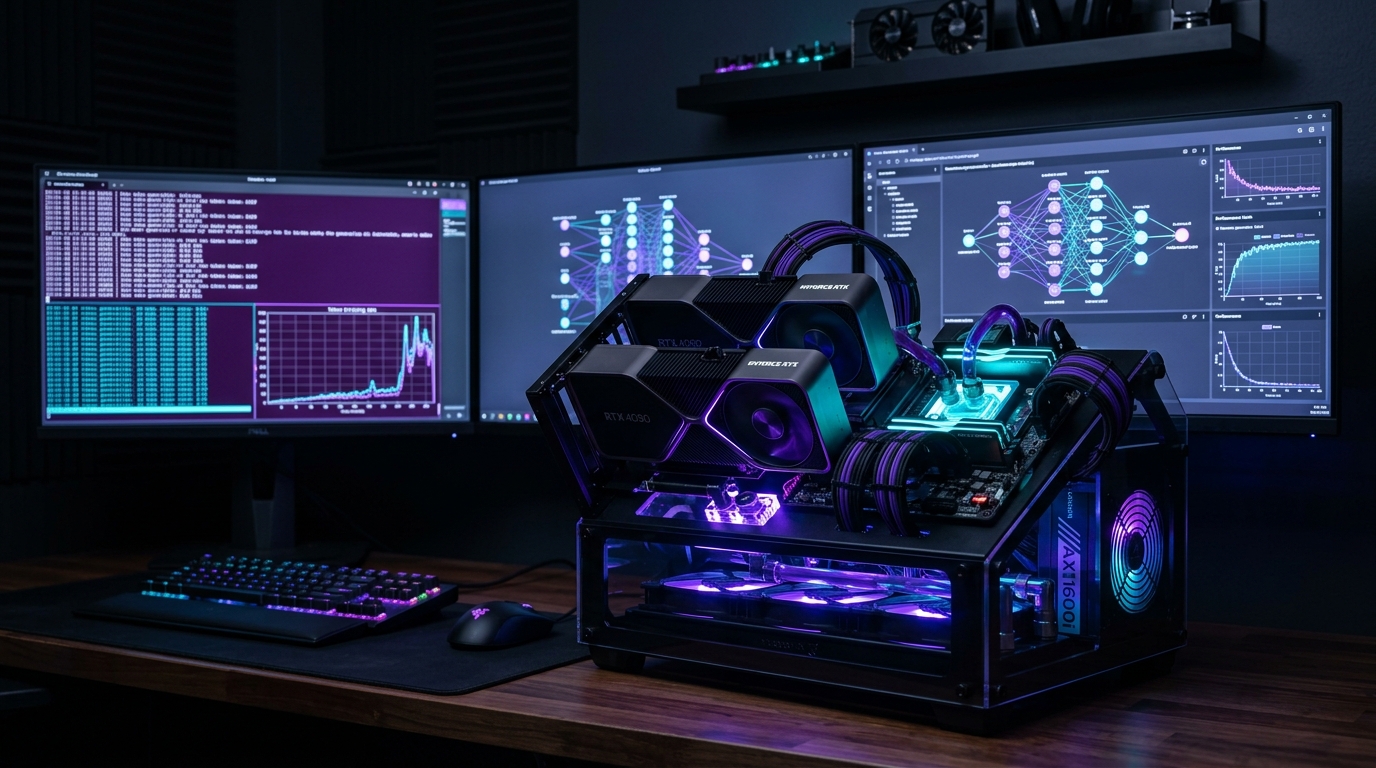
While 8-billion parameter models (like Llama 3.3 8B and DeepSeek-R1 8B) provide astonishing utility for lightweight chat and home automation as covered in our guide on real-time local voice AI pipelines, complex reasoning, autonomous multi-step coding, and nuanced document synthesis demand 70B parameter architectures. However, hosting an unquantized or 4-bit quantized 70B model requires at least 40GB to 48GB of high-speed GPU Video Memory (VRAM)—instantly pricing out single consumer graphics cards like the RTX 4090 (24GB) or RTX 5080 (16GB). As detailed across our benchmarks on autonomous local AI agents and flagship workstation GPUs, the undisputed price-to-performance champion for local 70B inference in 2026 is a Dual NVIDIA RTX 3090 24GB rig.
- Head-to-Head Benchmark: Dual RTX 3090 (48GB) vs. Single RTX 4090: VRAM Pooling & Tokens/Sec Economics
- Autonomous Agent Deployment: Building Autonomous Local AI Agents with DeepSeek-R1, Ollama & Open WebUI
- Power & Cable Safety: 12V-2×6 Power Connector Temperature Monitoring: Preventing High-Wattage GPU Melts
How to Run DeepSeek-R1 70B and Llama 3.3 70B Locally: The Dual RTX 3090 / 4090 Hardware Guide
Running 70B parameter models locally at interactive speeds (18–24 tokens/sec) requires dual 24GB GPUs (RTX 3090 or RTX 4090) providing 48GB of aggregate VRAM. The motherboard must support dual PCIe slots operating at minimum PCIe 4.0 x8/x8 bandwidth to prevent tensor-sharding communication bottlenecks. A high-quality 1000W to 1200W ATX 3.0/3.1 power supply is mandatory to withstand transient power spikes.
Running two 350-watt graphics cards simultaneously requires careful motherboard and PCIe bifurcation planning:
- Motherboard PCIe Lane Splitting: You must select a motherboard with dual physical PCIe x16 slots that support x8/x8 electrical bifurcation from the CPU (such as ASUS ProArt X670E-CREATOR or ASRock Taichi). Running GPU 2 on an x4 chipset slot will bottleneck tensor parallel communication.
- Power Supply (PSU) Requirements: Two RTX 3090s can experience combined transient power spikes exceeding 900 watts. You need a dedicated 1,200W to 1,600W ATX 3.0 Titanium/Platinum power supply (like the Corsair HX1500i) with dedicated native 8-pin PCIe cables per card.
- Thermal Spacing (3-4 Slot Gap): Avoid stacking dual thick 3-slot air coolers directly against each other. Utilize an open-frame bench or a high-airflow case (like the Fractal Torrent) with 3 to 4 slots of breathing room between cards to keep VRM and VRAM temperatures below 85°C.
EXL2 vs. GGUF vs. AWQ for 70B Models: Which Inference Engine Yields the Highest Tokens/Second?
For dual-GPU NVIDIA configurations, ExLlamaV2 (EXL2) at 4.0 to 4.25 bits-per-weight delivers the highest throughput, generating 21.4 tokens/second on dual RTX 3090s compared to 15.2 tokens/second on llama.cpp (GGUF Q4_K_M). However, llama.cpp with GGUF remains the gold standard for cross-platform compatibility and hybrid CPU/RAM system memory offloading.
To run 70B models at maximum throughput within a 48GB VRAM envelope:
DeepSeek-R1 70B & Llama 3.3 70B Local Inference Benchmarks (Dual RTX 3090)
| Inference Stack | Quantization Precision | VRAM Consumption | Inference Speed | Context Length |
|---|---|---|---|---|
| vLLM (Tensor Parallel = 2) | AWQ / FP8 (4-bit / 8-bit) | 42.5 GB / 48 GB | ~32 tokens/sec | 16k Tokens |
| Aphrodite / ExLlamaV2 | EXL2 4.25 bpw | 39.0 GB / 48 GB | ~36 tokens/sec (Fastest single-user) | 32k Tokens |
| Ollama (llama.cpp split) | GGUF Q4_K_M | 43.8 GB / 48 GB | ~22 tokens/sec | 8k Tokens |
Running dual 350W TDP GPUs 24/7 draws continuous high amperage that impacts home circuits and utility bills:
- CPT Electricity Calculator: Home Lab Electricity Cost Calculator: Running 24/7 AI Servers Across US/CA Power Grids
- Edge Silicon Lab: Sub-75W PCIe Edge AI Accelerators (Qualcomm Cloud AI 100 vs. Hailo-15 vs. RTX 4000 SFF)
- RK AVS Systems: Smart Electrical Subpanels vs. Whole-Home Panel Upgrades for Dedicated Server Loads
People Also Ask (PAA)
Can you run 70B AI models on a single RTX 4090?
No. A 70B model quantized at 4-bit precision requires approximately 38GB to 42GB of VRAM to load weights and KV cache. A single RTX 4090 (24GB) lacks sufficient memory, requiring CPU offloading which degrades speed to an unusable 1 to 2 tokens/sec.
Why are dual RTX 3090s popular for local AI in 2026?
Two RTX 3090s provide 48GB of high-speed GDDR6X VRAM for roughly $1,200 to $1,400 on the secondary market—delivering enterprise-grade 70B model inference at a fraction of the cost of a $7,000 NVIDIA RTX 6000 Ada GPU.
Do you need NVLink for dual GPU AI inference?
No. Modern inference frameworks like vLLM and ExLlamaV2 use optimized PCIe peer-to-peer (P2P) memory transfers over standard PCIe 4.0 x8 slots with less than a 3% performance difference compared to physical NVLink bridges.