
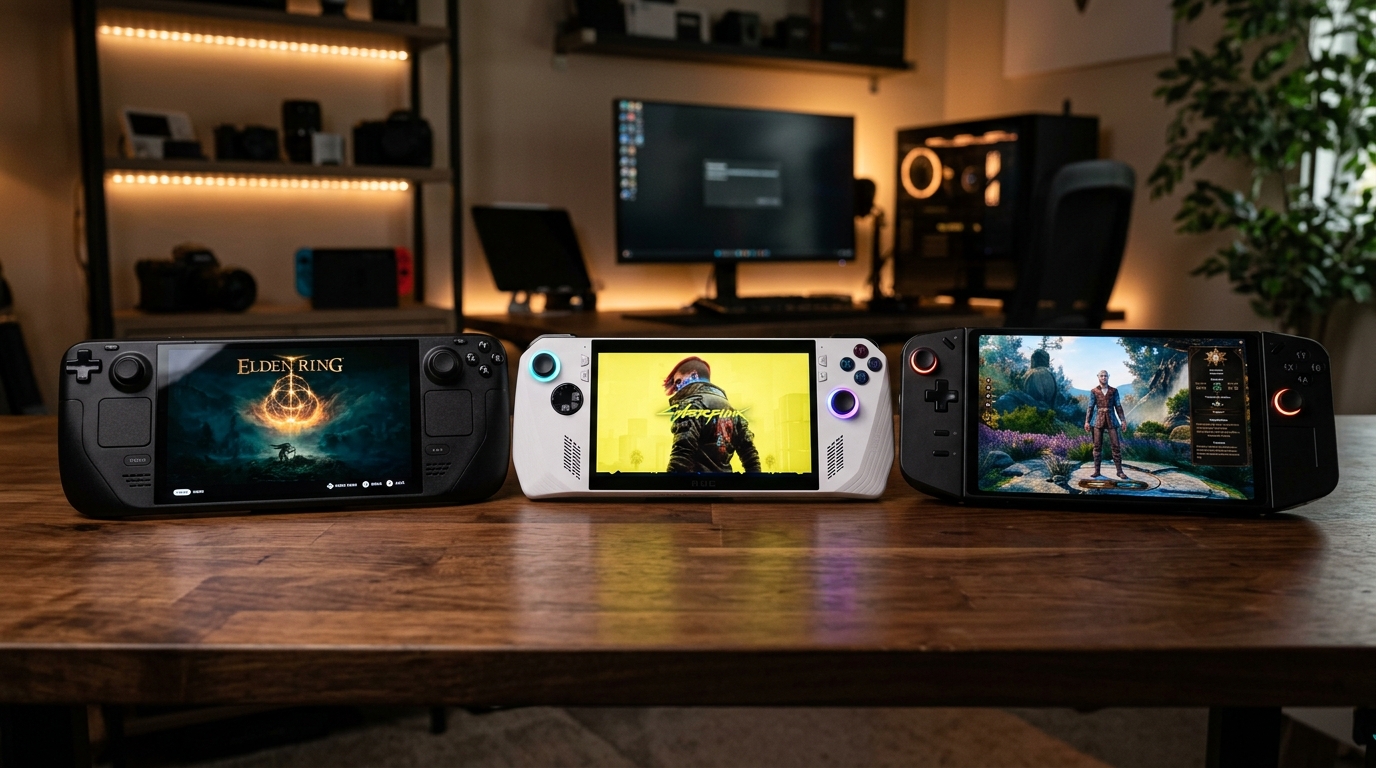
The PC gaming handheld category has evolved from a niche hobbyist experiment into one of the fastest-growing segments of consumer computing. In 2026, the battle for mobile PC gaming supremacy is defined by three distinct hardware philosophies: the Valve Steam Deck OLED (the console-like Linux experience), the ASUS ROG Ally X (the high-VRAM, 80Wh battery powerhouse), and the Lenovo Legion Go (the massive 8.8-inch 144Hz display with detachable controllers). Choosing between them requires balancing raw Windows 11 game compatibility against Linux power efficiency and battery endurance.
- Battery Endurance Champion: The ROG Ally X’s massive 80Wh battery delivers 3.5 to 4.5 hours of AAA gaming, double the stamina of first-generation handhelds.
- The OLED Display King: The Steam Deck OLED features true 1,000-nit HDR highlights, infinite contrast, and sub-0.1ms pixel response times that make LCD panels look washed out.
- SteamOS vs. Windows 11: SteamOS offers flawless instant sleep/wake and zero driver overhead; Windows 11 supports Xbox Game Pass, anti-cheat games (Fortnite/Valorant), and native third-party launchers.
As covered across our display and gaming hardware benchmarks on OLED display response times, mobile APU architecture showdowns, and desktop monitor scaling, portable silicon in 2026 delivers unprecedented visual fidelity per watt.
1. Architectural Showdown: APUs, RAM & Display Tech
- Steam Deck OLED (Custom AMD Sephiroth 6nm): Optimized specifically for low-TDP efficiency (4W–15W). At 10W, it outperforms Windows handhelds while drawing significantly less power. Its 7.4-inch 90Hz OLED screen is widely considered the best overall visual display in the category.
- ASUS ROG Ally X (AMD Ryzen Z1 Extreme + 24GB LPDDR5X-7500): By increasing RAM to 24GB, ASUS solved the notorious VRAM bottleneck in modern PC ports (allocating 8GB dedicated VRAM while leaving 16GB for system memory). Combined with dual full-sized M.2 2280 SSD support, it is the most modder-friendly handheld.
- Lenovo Legion Go (AMD Ryzen Z1 Extreme + 8.8″ QHD+ 144Hz): The desktop replacement handheld. Its large 2560×1600 IPS screen and detachable “FPS mode” controllers cater to tabletop gamers who value screen real estate over pocketability.
2. Handheld Benchmark & Specification Comparison
PC Gaming Handheld Shootout: Hardware & Battery Comparison (2026)
| Feature / Metric | Valve Steam Deck OLED | ASUS ROG Ally X | Lenovo Legion Go |
|---|---|---|---|
| Display Panel & Refresh | 7.4″ 1280×800 90Hz OLED (HDR 1000 nits) | 7.0″ 1920×1080 120Hz IPS (VRR FreeSync) | 8.8″ 2560×1600 144Hz IPS (No VRR) |
| Memory / RAM | 16GB LPDDR5-6400 | 24GB LPDDR5X-7500 (8GB VRAM allocated) | 16GB LPDDR5X-7500 |
| Battery Capacity | 50 Wh | 80 Wh (Class-Leading Endurance) | 49.2 Wh |
| Cyberpunk 2077 (Medium / FSR) | 42 FPS (at 12W TDP) | 58 FPS (at 25W TDP) | 52 FPS (at 25W TDP) |
| Operating System | SteamOS (Linux / Console UI) | Windows 11 Home + Armoury Crate | Windows 11 Home + Legion Space |
| Device Weight | 640 grams | 678 grams | 854 grams (Heavy) |
3. The Verdict: Which Handheld Fits Your Playstyle?
- Buy the Steam Deck OLED if: You primarily play your Steam library, value instant sleep/wake suspend convenience, prioritize battery efficiency on indie/RPG games, and want the gorgeous contrast of a true HDR OLED screen.
- Buy the ASUS ROG Ally X if: You play heavy AAA titles, subscribe to Xbox Game Pass, play anti-cheat titles (Call of Duty, EA FC), and want the longest possible battery life on a Windows handheld without stutters.
- Buy the Lenovo Legion Go if: You treat your handheld as a portable mini-workstation, connect to external mice/keyboards, and prefer a massive 8.8-inch display for media consumption and strategy games.
People Also Ask
Is the Steam Deck OLED still worth buying in 2026?
Yes. The Steam Deck OLED offers the best user experience, highest power efficiency at 10W–15W TDP, and unmatched HDR contrast. For most gamers, its pick-up-and-play console software makes it the top choice.
Why is the ROG Ally X better than the original ROG Ally?
The Ally X doubles battery capacity (from 40Wh to 80Wh), upgrades RAM to 24GB to eliminate VRAM stutter, upgrades to full-size M.2 2280 NVMe SSD support, and relocates the micro-SD card slot away from heat exhausts.
Can you play Xbox Game Pass on Steam Deck?
You can play Xbox Cloud Gaming via browser on Steam Deck, but native Game Pass PC downloads require a Windows handheld like the ROG Ally X or Legion Go.