
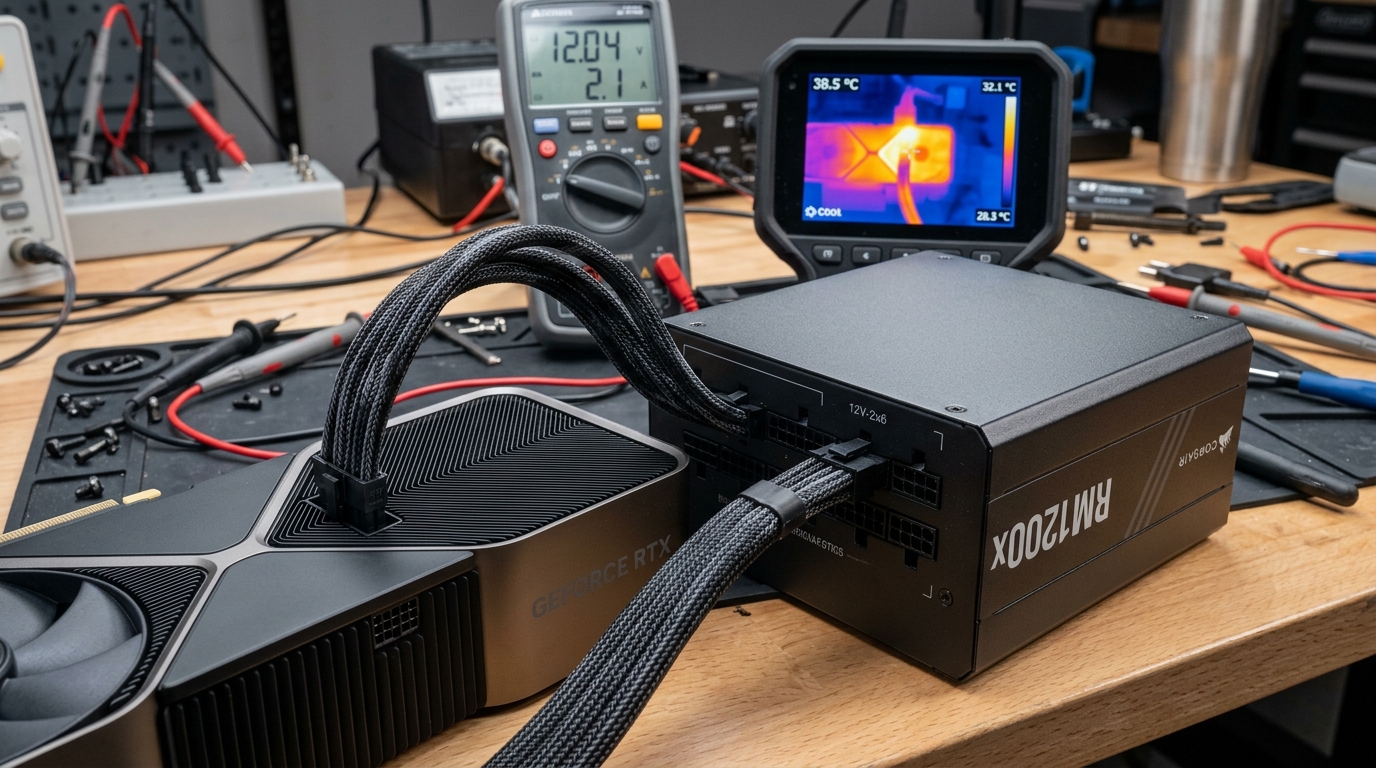
When high-wattage graphics cards (specifically the RTX 4090) launched with the original 16-pin 12VHPWR power connector, PC building communities were plagued by alarming reports of melted cable plugs, burned PCB sockets, and catastrophic hardware failures. In 2026, the industry standard has officially transitioned to ATX 3.1 and PCIe 5.1. The revised 12V-2×6 connector introduces vital physical pin re-engineering and relaxed hold-up time standards that eliminate melting hazards while delivering up to 600 Watts of continuous clean power over a single cable.
- The 12V-2×6 Fix: Sense pins were shortened by 1.7mm and power conductors lengthened by 0.25mm. If the cable is not 100% seated, the GPU safely refuses to power on.
- ATX 3.1 Transient Spikes: Certified PSUs must safely absorb 200% excursion spikes (e.g. 2,000W peak on a 1,000W PSU) for 100 microseconds without tripping OPP shutdown.
- Hold-Up Time Adjustment: ATX 3.1 relaxed AC loss hold-up requirements from 17ms down to 12ms, reducing internal capacitor heat and improving PSU longevity.
As explored across our PC building and benchmarking analyses on RTX 50-series power efficiency benchmarks, high-wattage dual-GPU local AI rigs, and motherboard PCIe lane bandwidth, proper power delivery is the foundation of hardware reliability.
1. How the 12V-2×6 Design Prevents Connector Thermal Runaway
The root cause of original 12VHPWR failures was partial insertion: if a cable was seated at a slight angle, the four tiny sense pins would still register electrical contact, but the 12 main power pins had uneven surface contact. This caused massive electrical resistance (I²R losses) and thermal runaway exceeding 150°C. In the PCIe 5.1 12V-2×6 standard:
- The four sideband/sense pins are recessed deeper inside the housing. If the connector is backed out by even 1.5mm, the sense pins break contact immediately, shutting down the 12V rail before heat can build.
- The twelve 12V power pins are longer and thicker, guaranteeing greater physical surface area contact inside the female terminal.
2. Specification Comparison: ATX 3.0 vs. ATX 3.1
Power Supply Architecture: ATX 3.0 vs. ATX 3.1 Standard (2026 Benchmark)
| Technical Parameter | ATX 3.0 (PCIe 5.0 / Legacy 12VHPWR) | ATX 3.1 (PCIe 5.1 / New 12V-2×6) |
|---|---|---|
| Primary GPU Power Connector | 12VHPWR (Flush sense pins / Melting risk) | 12V-2×6 (Recessed sense pins / Zero-heat interlock) |
| Power Delivery Rating | Up to 600W (Continuous) | Up to 600W (Continuous with thermal safety margin) |
| Transient Excursion Tolerance | 200% of rated PSU wattage for 100μs | 200% of rated PSU wattage for 100μs |
| AC Hold-Up Time Requirement | 17ms at 100% continuous load | 12ms at 100% continuous load (Lower stress on caps) |
| Backward Compatibility | Requires 8-pin to 16-pin octopus adapter | 100% Cross-compatible with all PCIe 5.0/5.1 GPUs |
3. Do You Need to Upgrade Your Power Supply in 2026?
- Keep your current PSU if: You already own a high-tier ATX 3.0 unit (Corsair RMx, Seasonic Focus, be quiet! Dark Power) and use a dedicated 12V-2×6 replacement cable provided directly by the manufacturer.
- Buy an ATX 3.1 PSU if: You are building a new PC around an RTX 4080 Super, RTX 4090, or next-generation RTX 50-series card and want a native 12V-2×6 port directly on the power supply casing, eliminating cumbersome 3x 8-pin adapter splitters.
People Also Ask
What is the difference between 12VHPWR and 12V-2×6?
12V-2×6 is the PCIe 5.1 update to 12VHPWR. It recesses the four small sense pins and lengthens the main power conductors, preventing the GPU from receiving power if the cable is not fully plugged in.
Can you plug a 12V-2×6 cable into an older RTX 4090?
Yes. The physical connector dimensions are 100% backward compatible with all RTX 40-series and 50-series graphics cards that use 16-pin power headers.
Is ATX 3.1 better than ATX 3.0?
Yes. ATX 3.1 incorporates the safer 12V-2×6 connector specification and optimizes AC hold-up time standards to improve long-term power supply reliability and component lifespan.