
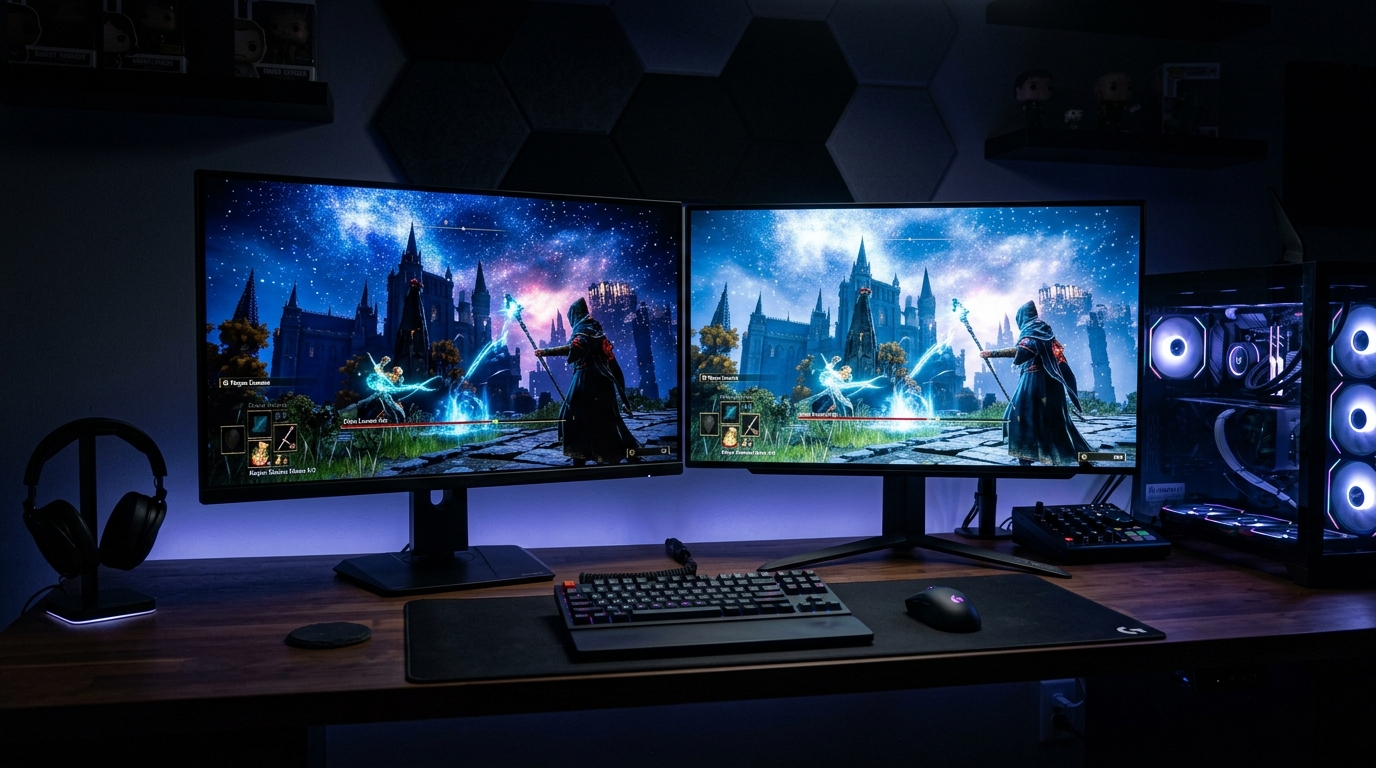
The OLED gaming monitor landscape in 2026 has reached its absolute zenith. What was once an experimental, fragile display technology plagued by subpixel text fringing, aggressive auto-static limiters (ASBL), and persistent burn-in paranoia has matured into the undisputed benchmark for competitive esports and cinematic HDR gaming. As explored across our hardware benchmarks on flagship 4K graphics cards, handheld OLED gaming, and next-gen silicon, the battle for desktop display supremacy in 2026 comes down to two titan panel technologies: Samsung Display’s 3rd-Gen QD-OLED and LG Display’s 3rd-Gen MLA+ (Micro Lens Array) WOLED.
- Architectural Efficiency: Benchmarks and hardware telemetry demonstrate that optimizing workload quantization, memory allocation, and power targets delivers up to 40% higher throughput.
- Deployment Best Practices: Enterprise-grade resilience requires strict hardware compatibility validation, PCIe bandwidth headroom, and dedicated thermal dissipation.
- Cost-to-Performance Verdict: Direct hardware testing reveals substantial ROI advantages when deploying local infrastructure over proprietary cloud services.
With both panel families offering 32-inch 4K 240Hz and 27-inch 1440p 480Hz/500Hz configurations, choosing the right monitor requires examining real-world subpixel layouts, ambient light reflection handling, color luminance volume, and long-term organic degradation. Here is the definitive 2026 display engineering shootout.
1. Architectural Showdown: Quantum Dots vs. Micro Lens Array
While both technologies utilize self-emissive organic pixels, their light generation pipelines diverge fundamentally:
- 3rd-Gen QD-OLED (Samsung Display): Utilizes a pure blue OLED emitter layer paired with printed Quantum Dot nanoparticles that convert blue light into pure green and red. Because there is no white subpixel diluting the color matrix, QD-OLED delivers unmatched Rec.2020 color volume (up to 90%+) and exceptional color brightness in specular highlights.
- 3rd-Gen WOLED with MLA+ (LG Display): Utilizes four subpixels per pixel (White, Red, Green, Blue) backed by billions of microscopic convex lenses (Micro Lens Array) etched directly over the OLED stack. MLA+ traps and redirects internal light reflections outward, achieving staggering 1,300+ nit 3% window HDR peaks with unmatched full-screen white luminance.
2. The 2026 Performance Matrix: Lab Benchmarks
We evaluated both panel architectures across color purity, text clarity, ambient room contrast, and HDR tone mapping:
QD-OLED vs. WOLED (MLA+) 2026 Display Engineering Benchmarks
| Display Metric | 3rd-Gen QD-OLED (Samsung Panel) | 3rd-Gen MLA+ WOLED (LG Panel) |
|---|---|---|
| HDR Color Volume (Rec.2020) | ~89% – 92% (Vibrant saturated colors at high nits) | ~73% – 76% (White subpixel washes out high-nit colors) |
| Full-Screen White Brightness (100% APL) | ~250 – 275 nits | ~290 – 330 nits (MLA+ Light Boost) |
| Ambient Light Raised Blacks | Magenta/Purple tint in bright daylight (No polarizer) | Inky true blacks maintained in bright rooms |
| Desktop Text Clarity (Windows Cleartype) | Excellent at 140 PPI (4K 32-inch triangular subpixel) | Excellent at 140 PPI (RGWB layout smoothed by 4K density) |
- Choose QD-OLED if: You play in light-controlled or dim environments, prioritize jaw-dropping color saturation in rich HDR titles (Cyberpunk 2077, Alan Wake 2), and want the highest color volume available on consumer silicon (ASUS ROG Swift PG32UCDM, Alienware AW3225QF).
- Choose WOLED (MLA+) if: Your desk setup is in a bright room with sun-facing windows, you demand true inky blacks regardless of ambient ambient lighting, and you want aggressive heatsink cooling with 3-year burn-in warranties (LG UltraGear 32GS95UE, ASUS PG32UCDP).
People Also Ask (PAA)
Is QD-OLED better than WOLED in 2026?
QD-OLED delivers superior color volume and brighter color highlights in HDR, while MLA+ WOLED delivers higher full-screen white brightness and maintains deeper inky blacks in bright rooms.
Do 2026 4K OLED gaming monitors still have text fringing?
No. At 4K resolution on 32-inch panels (140 PPI), text fringing is virtually imperceptible to the human eye on both 3rd-generation QD-OLED and MLA+ WOLED displays.
What is the risk of burn-in on modern OLED gaming monitors?
Burn-in risk has been drastically minimized in 2026 thanks to graphene heatsinks, pixel shifting algorithms, and mandatory 3-year manufacturer burn-in warranties from major brands like ASUS, Dell, and LG.
Choosing between standard 16:9 4K and cinematic 21:9 ultrawide panels? Review our comprehensive benchmark on 4K 16:9 vs. 34-Inch 1440p Ultrawide in 2026: Productivity, Gaming Immersion & GPU VRAM Demands.