
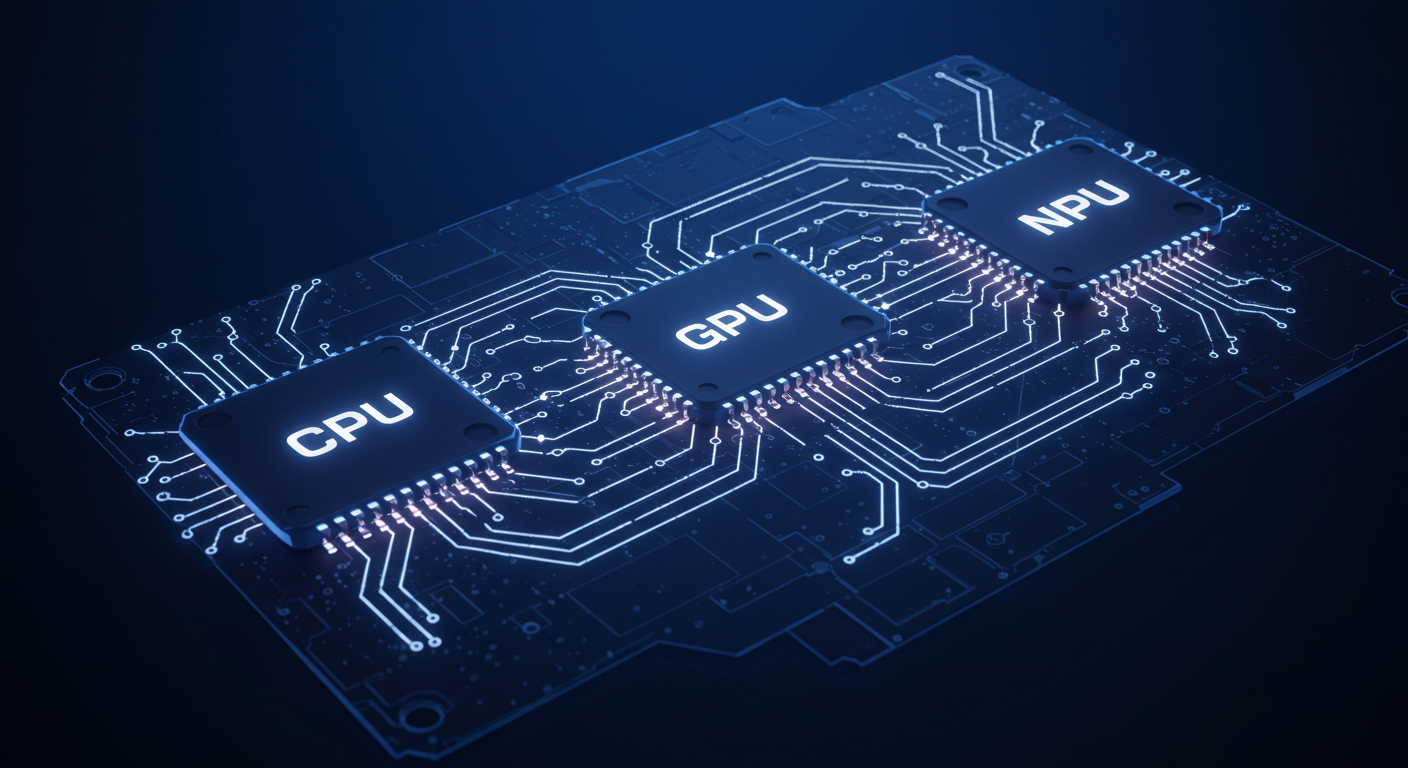
Over the past two years, the consumer and enterprise PC marketing machine has been dominated by a single acronym: NPU (Neural Processing Unit). Spearheaded by Microsoft’s Copilot+ PC mandate requiring a baseline of 40 NPU TOPS (Trillion Operations Per Second), silicon manufacturers—from Qualcomm and Intel to AMD and Apple—have fundamentally redesigned their system-on-chip (SoC) architectures to dedicate valuable die real estate to dedicated matrix-multiplication acceleration engines.
Yet, for system administrators, machine learning engineers, and homelab enthusiasts actually attempting to run local open-weights intelligence—such as DeepSeek-R1 distillations, Llama 3.3 70B, or Qwen 2.5 coder models—there is a profound disconnect between retail silicon marketing and computational reality. The industry metric of “NPU TOPS” is primarily an INT8 integer metric measured under narrow compute-bound vision and audio filter workloads. When executing autoregressive Large Language Model (LLM) token generation, the performance bottleneck shifts entirely from raw processing capacity to an immutable physical constraint: memory bandwidth.
- The Memory Bandwidth Wall: Autoregressive LLM inference during the generation phase is strictly memory-bandwidth bound. Every single token generated requires reading every parameter in the quantized model from memory. A 50-TOPS NPU paired with a standard 128-bit LPDDR5X memory bus (85 GB/s) is physically incapable of generating tokens faster than roughly 18–20 tokens/sec on an 8-billion parameter model, regardless of NPU compute headroom.
- The Architectural NPU Sweet Spot: NPUs excel at continuous, background, low-power ambient tasks (real-time video background blur, voice isolation, on-device OCR, and embedding generation) drawing 2W to 5W of power, where firing up a discrete GPU would drain laptop battery life within 90 minutes.
- Apple Silicon’s Unified Memory Moat: Apple’s M4 Pro and M4 Max platforms continue to dominate mobile workstation LLM inference not because of their 38-TOPS Neural Engine, but because their ultra-wide unified memory architectures deliver 273 GB/s to 546 GB/s of bandwidth shared directly with high-core-count GPUs.
- Desktop CUDA vs. Client NPUs: For serious 14B, 32B, and 70B local model execution, discrete desktop GPUs (such as dual RTX 3090/4090s or RTX Blackwell) delivering 1,000+ GB/s of GDDR6X/GDDR7 bandwidth through PCIe 5.0 remain the only viable enterprise deployment standard.
Lunar Lake vs. Strix Point vs. Apple M4: Which 2026 Laptop NPU Runs Local AI Faster?
For local LLM inference in 2026, Apple M4 Pro/Max decisively outperforms Intel Lunar Lake and AMD Strix Point, generating 45+ tokens/second on 14B models due to its massive 273–546 GB/s unified memory bandwidth. While AMD Strix Point (50 TOPS) and Intel Lunar Lake (48 TOPS) satisfy Copilot+ AI PC requirements, their 128-bit LPDDR5X bus (85–136 GB/s) bottlenecks local LLM generation to 14–22 tokens/second.
- Desktop GPU Selection: Best GPUs for DeepSeek-V3 & Local Reasoning (VRAM Calculator & Benchmarks)
- Autonomous Agent Pipelines: Building Autonomous Local AI Agents with DeepSeek-R1, Ollama & Open WebUI
- Dual RTX 3090 Setups: Dual RTX 3090 (48GB) vs. Single RTX 4090: VRAM Pooling & Tokens/Sec Economics
The Arithmetic of Local LLM Inference: Why TOPS Doesn’t Equal Speed
To understand why a 50-TOPS Copilot+ laptop cannot replace an NVIDIA workstation, one must examine the operational phases of Transformer inference: the prefill phase (prompt ingestion) and the generation phase (token decoding).
During the prefill phase, all prompt tokens are processed in parallel, making the workload compute-bound. Here, high TOPS ratings accelerate the Time-To-First-Token (TTFT). However, once generation begins, tokens are emitted sequentially one at a time. To emit a single token, the processor must stream all weights of the model from system RAM into the computational registers:
Consider a quantized 8-billion parameter model (Llama 3.1 8B at Q4_K_M quantization), which occupies approximately 4.92 GB of memory:
- Standard Copilot+ PC (Snapdragon X Elite / Intel Lunar Lake): Features dual-channel 128-bit LPDDR5X-8533 memory delivering approximately 85.3 GB/s theoretical peak bandwidth (typically ~70 GB/s achievable in practice).
Theoretical Max Speed = 70 GB/s / 4.92 GB = ~14.2 tokens/second. - Apple M4 Pro (Unified Memory): Features a 256-bit bus delivering 273 GB/s bandwidth.
Theoretical Max Speed = 273 GB/s / 4.92 GB = ~55.4 tokens/second. - NVIDIA GeForce RTX 4090 / 5080: Features 384-bit/256-bit GDDR6X/GDDR7 delivering 1,008 GB/s bandwidth.
Theoretical Max Speed = 1,008 GB/s / 4.92 GB = ~204.8 tokens/second.
No matter how many TOPS an NPU manufacturer claims, an NPU connected to an 85 GB/s memory pipe cannot break the fundamental laws of data movement.
Silicon Architecture Matrix: NPU TOPS vs. Memory Bandwidth in 2026
The following architectural matrix compares the leading consumer, workstation, and enterprise client AI processors across physical die configurations, peak NPU TOPS, memory bandwidth, and real-world LLM execution viability:
| Silicon Platform | NPU Architecture & INT8 TOPS | Memory Type & Bus Width | Peak Memory Bandwidth | Llama 3.1 8B Q4 Decode Speed | Max Practical Model Tier |
|---|---|---|---|---|---|
| Qualcomm Snapdragon X Elite | Hexagon NPU (45 TOPS) | 128-bit LPDDR5X-8448 | 135 GB/s (Shared) | 18 – 22 tok/s | 7B – 8B (Q4) |
| Intel Core Ultra 200V (Lunar Lake) | NPU 4.0 (48 TOPS) | 128-bit On-Package LPDDR5X | 85.3 GB/s | 14 – 17 tok/s | 7B – 8B (Q4) |
| AMD Ryzen AI 9 HX 370 (Strix Point) | XDNA 2 (50 TOPS) | 128-bit LPDDR5X-7500 | 120 GB/s | 16 – 20 tok/s | 7B – 8B (Q4) |
| Apple M4 Pro / M4 Max | 16-Core Neural Engine (38 TOPS) | 256-bit / 512-bit Unified Memory | 273 – 546 GB/s | 52 – 105 tok/s | 32B – 70B (Max Unified) |
| NVIDIA GeForce RTX 5080/5090 | 5th-Gen Tensor Cores (1,800+ FP8 TOPS) | 384-bit / 512-bit GDDR7 | 1,152 – 1,792 GB/s | 180 – 260+ tok/s | 70B+ (Multi-GPU / EXL2) |
The True Purpose of NPUs: Continuous Ambient Acceleration
While NPUs are unsuited for running massive generative reasoning models, dismissing them as useless marketing fluff misunderstands their true engineering value. NPUs are purpose-built for energy-efficient ambient acceleration:
- Thermal & Battery Efficiency: An NPU executing a background noise-suppression model or face-tracking camera algorithm consumes between 1.5W and 3W. The same workload run on a discrete GPU would spin up cooling fans, draw 35W to 50W, and cause laptop thermal throttling.
- Zero GPU Contention: Offloading small, continuous AI operations (such as Windows Recall semantic embedding generation or IDE syntax autocompletion) to the NPU leaves the primary GPU entirely free for heavy 3D rendering, video encoding, or gaming.
- Edge Privacy: NPUs allow sensitive biometrics, meeting transcription, and personal file vectorization to execute locally on-device without leaking data to cloud servers.
Software Runtime Ecosystems: ONNX, DirectML vs. llama.cpp
The final hurdle facing client NPU adoption is software runtime fragmentation. In the discrete GPU landscape, NVIDIA’s CUDA is the undisputed enterprise monopoly, supported natively by PyTorch, vLLM, TensorRT-LLM, and Ollama.
For NPUs, developers must navigate a fractured API landscape:
- Microsoft DirectML & ONNX Runtime: The primary runtime for Windows Copilot+ hardware. While DirectML allows models to target Qualcomm Hexagon, Intel NPU, and AMD XDNA through a single abstraction layer, runtime overhead often degrades raw execution speed compared to bare-metal CUDA.
- Apple MLX: Apple’s open-source framework targets Apple Silicon’s unified memory architecture natively. Because MLX executes across the M-series GPU and CPU cache with unified access to system RAM, it provides the most seamless, high-performance consumer LLM experience outside of Linux CUDA servers.
- llama.cpp & Vulkan/OpenCL Backends: Community-driven engines like llama.cpp have begun integrating experimental NPU backends (such as Intel OpenVINO and Qualcomm QNN). However, for the majority of users, running quantized GGUF models on the integrated or discrete GPU remains significantly faster than targeting the NPU.
Do not buy a PC or laptop based on NPU TOPS ratings if your primary objective is running local Large Language Models. An NPU is an ambient efficiency coprocessor—a low-power engine designed to handle camera effects, voice isolation, and continuous embedding tasks without killing your battery. For actual local LLM inference, memory bandwidth is king. A 45-TOPS NPU handcuffed to an 85 GB/s memory bus will never outpace an Apple Silicon M4 with 273 GB/s or a dedicated desktop GPU with 1,000+ GB/s of VRAM. If you want a mobile machine capable of running 14B to 70B models, invest in unified memory bandwidth (Apple Silicon) or discrete NVIDIA silicon. Use NPUs for what they were engineered for: silent, efficient background utility.
Explore transistor-level architecture teardowns and dedicated NPU benchmarking across our sister laboratory:
People Also Ask
What does NPU TOPS mean in PC hardware?
TOPS stands for ‘Trillion Operations Per Second.’ In NPU hardware, it measures the peak theoretical computational throughput of the processor when executing low-precision integer operations (typically 8-bit INT8 matrix multiplications). Microsoft’s Copilot+ standard requires a minimum of 40 NPU TOPS.
Can an NPU run a local LLM like Llama 3 or DeepSeek?
Yes, but primarily for smaller 1B to 8B parameter models. Because LLM token generation is limited by system memory bandwidth rather than raw compute speed, an NPU connected to standard 128-bit laptop RAM will generally generate tokens at roughly 14 to 20 tokens per second, significantly slower than a discrete GPU.
Why is memory bandwidth more important than TOPS for local AI?
During LLM text generation, every single token output requires streaming every single parameter in the model from memory to the processor. Even if an NPU has massive computational capacity, it must sit idle waiting for weights to arrive if memory bandwidth is insufficient.
Why does Apple Silicon outperform Windows Copilot+ PCs in local AI?
Apple Silicon M-series Pro and Max chips utilize wide 256-bit and 512-bit unified memory architectures delivering between 273 GB/s and 546 GB/s of bandwidth—more than triple the 85 GB/s to 135 GB/s found on typical Intel Lunar Lake or Qualcomm Snapdragon laptops.