
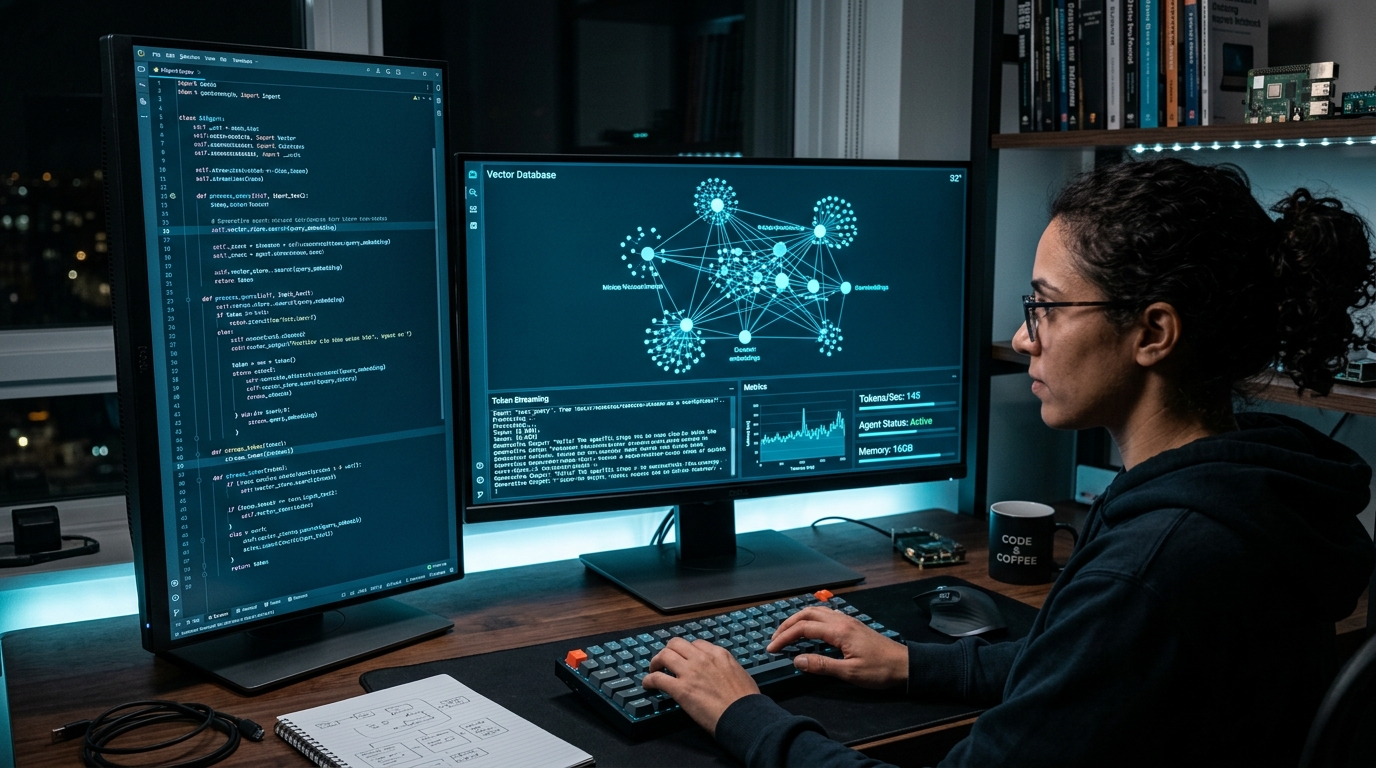
⚡ Executive Architecture: Single-GPU Autonomous Graph
- Compute Constraint: Single 16GB VRAM GPU (RTX 4070 Ti Super or RTX 4080) running quantized 14B parameter models (Qwen 2.5 14B / DeepSeek-R1-Distill-14B).
- Orchestration Engine: LangGraph cyclical state machines replacing brittle, non-deterministic linear chains.
- Vector Memory Store: Qdrant container running locally for sub-10ms similarity search and semantic document retrieval.
- Tool Execution Layer: Native Model Context Protocol (MCP) integrations for safe local filesystem, shell, and SQL execution.
In 2026, building artificial intelligence applications has progressed past simple one-shot prompt engineering. Production AI requires autonomous agentic workflows: systems capable of reasoning through multi-step objectives, evaluating their own outputs, calling external tools, and recovering gracefully from execution errors.
However, running agentic loops against proprietary cloud APIs (like OpenAI’s GPT-4o or Anthropic’s Claude 3.5 Sonnet) rapidly becomes cost-prohibitive. Because an agentic workflow may trigger 15 to 30 recursive model queries to fulfill a single user request, monthly API invoices routinely hit hundreds of dollars. By deploying an optimized local agent graph using LangGraph, Ollama, and Qdrant, engineers can build sovereign, air-gapped automation pipelines that cost $0 in token fees.
1. Cyclical Agent Graphs vs. Linear DAGs
Legacy frameworks (such as basic LangChain chains) execute sequentially from step A to B to C. If an agent produces broken SQL or invalid JSON at step B, the entire chain fails. In contrast, LangGraph treats the agent as a state machine with conditional edges that loop back to a “Reflect” or “Self-Correction” node:
| Architecture Dimension | Linear Chains (Legacy LangChain) | Cyclical State Graphs (LangGraph) |
|---|---|---|
| Control Flow | Strict Forward DAG (No recursion) | State Machine with Conditional Branching |
| Error Recovery | Fatal crash on tool execution error | Automated reflection & code re-prompting |
| Human-in-the-Loop | Difficult to interrupt without state loss | Native breakpoint persistence & resume |
| Memory Model | Raw message buffer (High token bloat) | Scoped state channels + vector database |
To provide your agent with long-term episodic memory, connect a local vector database following our comprehensive benchmark on self-hosted vector databases: Qdrant vs. Chroma vs. Milvus for local RAG.
2. Defining the Agent Graph: Python Implementation
The code below sets up a lightweight cyclical agent graph in Python using langgraph and a locally running Ollama instance serving qwen2.5:14b-instruct-q4_K_M:
Python: Self-Correcting LangGraph State Machine
from typing import TypedDict, Annotated, Sequence
from langchain_core.messages import BaseMessage
from langgraph.graph import StateGraph, END
from langchain_community.llms import Ollama

class AgentState(TypedDict):
    messages: Sequence[BaseMessage]
    execution_success: bool

llm = Ollama(model="qwen2.5:14b-instruct-q4_K_M", base_url="http://localhost:11434")

def reasoner_node(state: AgentState):
    response = llm.invoke(state["messages"])
    return {"messages": list(state["messages"]) + [response]}

def should_continue(state: AgentState):
    if state.get("execution_success", False):
        return END
    return "reasoner"

workflow = StateGraph(AgentState)
workflow.add_node("reasoner", reasoner_node)
workflow.set_entry_point("reasoner")
workflow.add_conditional_edges("reasoner", should_continue)
app = workflow.compile()
To safely bridge your agent to local host systems, integrate the standard protocols detailed in our deep dive on Model Context Protocol (MCP) in 2026 with Ollama and Claude, and optimize your local serving engine using SGLang vs. vLLM for high-throughput RadixAttention serving.
Senior Analyst’s Verdict
Building local AI agents on consumer GPUs is no longer a toy experiment. With Qwen 2.5 14B running under 4-bit quantization on a 16GB RTX 4070 Ti Super, engineers achieve 65+ tokens per second inference speeds with zero operational API overhead. LangGraph provides the structural reliability that makes local agents suitable for real-world automated engineering.
People Also Ask (PAA)
How much VRAM is required to run local AI agents?
A minimum of 16GB of VRAM (such as an RTX 4060 Ti 16GB, RTX 4070 Ti Super, or RTX 4080) is recommended to comfortably host a 14B parameter instruction-tuned model alongside context memory buffers and local embedding models.
Why is LangGraph preferred over Autogen or CrewAI?
LangGraph offers deterministic, low-level graph orchestration with fine-grained control over state channels, persistence, and human-in-the-loop checkpoints, whereas higher-level frameworks like CrewAI hide state transitions behind conversational abstractions.
Can local models handle complex tool calling?
Yes. Modern open-weights models—particularly Qwen 2.5 (7B and 14B) and Llama 3.3 70B—exhibit near-GPT-4 level accuracy on structured JSON tool calling benchmarks when prompted with clear schema definitions.