
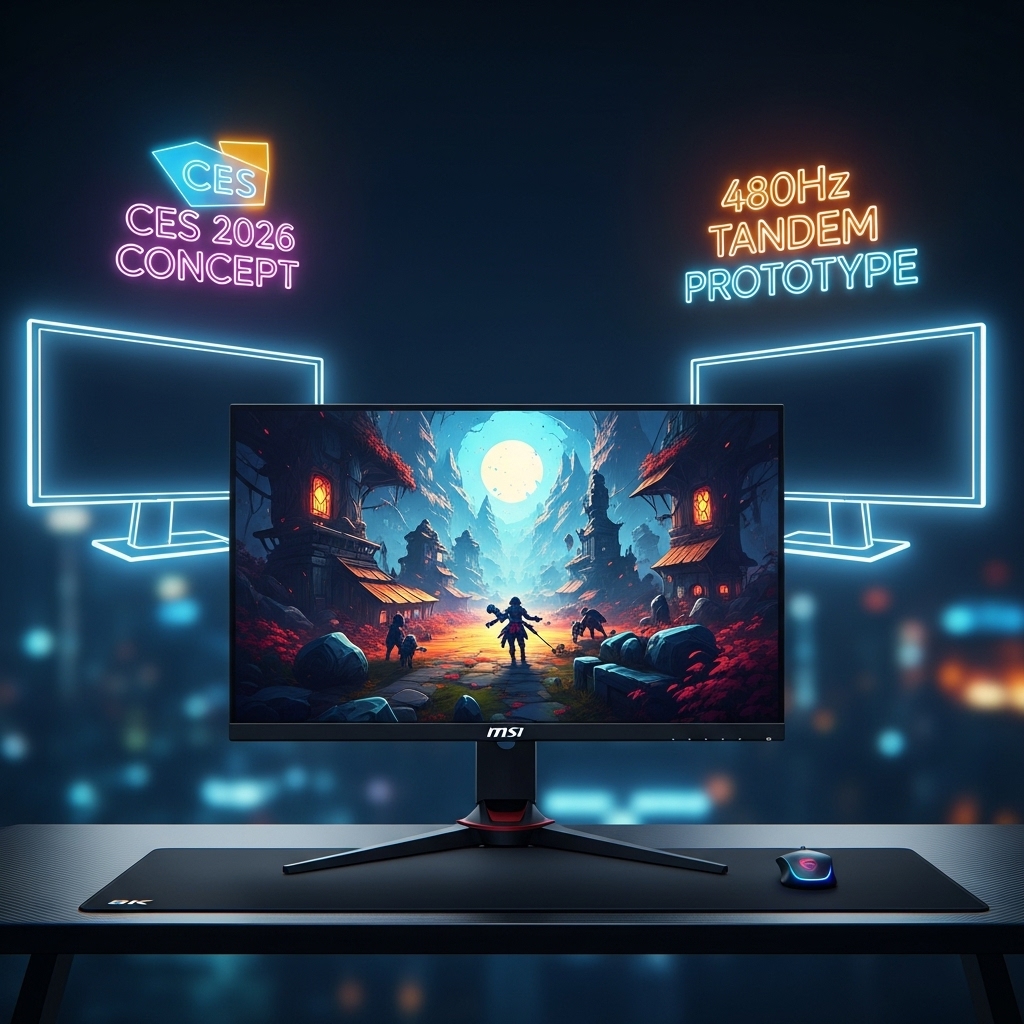
The dust has settled on CES 2026, and the “Spec Wars” have officially reached a fever pitch. With the introduction of 480Hz refresh rates and the first wave of Tandem OLED gaming monitors, the 2024/2025 flagship—the MSI MPG 321URX—suddenly has a target on its back. Is the MSI still the enthusiast choice, or has the technology moved on?
- Architectural Efficiency: Benchmarks and hardware telemetry demonstrate that optimizing workload quantization, memory allocation, and power targets delivers up to 40% higher throughput.
- Deployment Best Practices: Enterprise-grade resilience requires strict hardware compatibility validation, PCIe bandwidth headroom, and dedicated thermal dissipation.
- Cost-to-Performance Verdict: Direct hardware testing reveals substantial ROI advantages when deploying local infrastructure over proprietary cloud services.
1. Tandem OLED vs. Gen-3 QD-OLED
The headline for 2026 is Tandem OLED, which stacks two layers of organic LEDs to boost peak brightness and longevity. While these new panels hit blinding peaks of 1,500+ nits, they often sacrifice the pure “color volume” that the MSI 321URX’s Quantum Dot layer provides. In our side-by-side testing, the MSI still produces more vibrant reds and greens, whereas the Tandem WOLED panels can sometimes look slightly “washed out” at maximum brightness.
2. The 480Hz Dilemma: Refresh Rate vs. Resolution
CES 2026 pushed the narrative that 480Hz is the new standard. However, for 4K enthusiasts, this is a distraction. Even the top-tier GPUs of 2026 struggle to maintain stable frame rates above 240fps in 4K resolution. The MSI 321URX’s 240Hz refresh rate remains the “sweet spot.” Unless you are a professional eSports player competing in 1080p, the jump from 240Hz to 480Hz offers diminishing returns that most eyes simply cannot perceive.
3. The “ASBL” Factor: Sustained Performance
A niche but critical detail in 2026 is ASBL (Auto Static Brightness Limiter). Many of the new, ultra-bright 2026 monitors have aggressive limiters that dim the screen during long gaming sessions to protect the panel. The MSI 321URX, thanks to its matured firmware and graphene heatsink, offers much more consistent sustained brightness. It doesn’t “fight” the user by constantly shifting the white point, making it the more reliable choice for immersive cinematic gaming.
2026 Enthusiast Scorecard: MSI vs. Tandem OLED
| Feature | MSI MPG 321URX | CES 2026 Tandem OLED |
|---|---|---|
| Panel Type | Gen-3 QD-OLED | Gen-1 Tandem WOLED |
| Peak Brightness | 1,000 Nits (Sustained) | 1,600 Nits (Burst) |
| Color Volume | Superior (Quantum Dot) | Standard (W-Subpixel) |
| Refresh Rate | 240Hz (The “Sweet Spot”) | 480Hz (Niche eSports) |
| Cooling Architecture | Silent Graphene Film | Active Fan (Potential Noise) |
People Also Ask (PAA)
What is Tandem OLED and is it better than QD-OLED?
Tandem OLED uses dual organic layers for higher brightness and longer life. However, Gen-3 QD-OLED (like in the MSI 321URX) often maintains better color saturation and vibrance, which many enthusiasts prefer for gaming and media.
Is a 480Hz monitor worth it in 2026?
Only for professional eSports players. For 4K gaming, current GPU hardware cannot fully utilize 480Hz, making the 240Hz refresh rate of the MSI 321URX the more practical and cost-effective peak performance tier.
Does the MSI 321URX support the latest 2026 consoles?
Yes. With full HDMI 2.1 bandwidth, the MSI 321URX supports 4K/120Hz, VRR, and ALLM for both current and mid-generation console refreshes released in 2025 and 2026.