
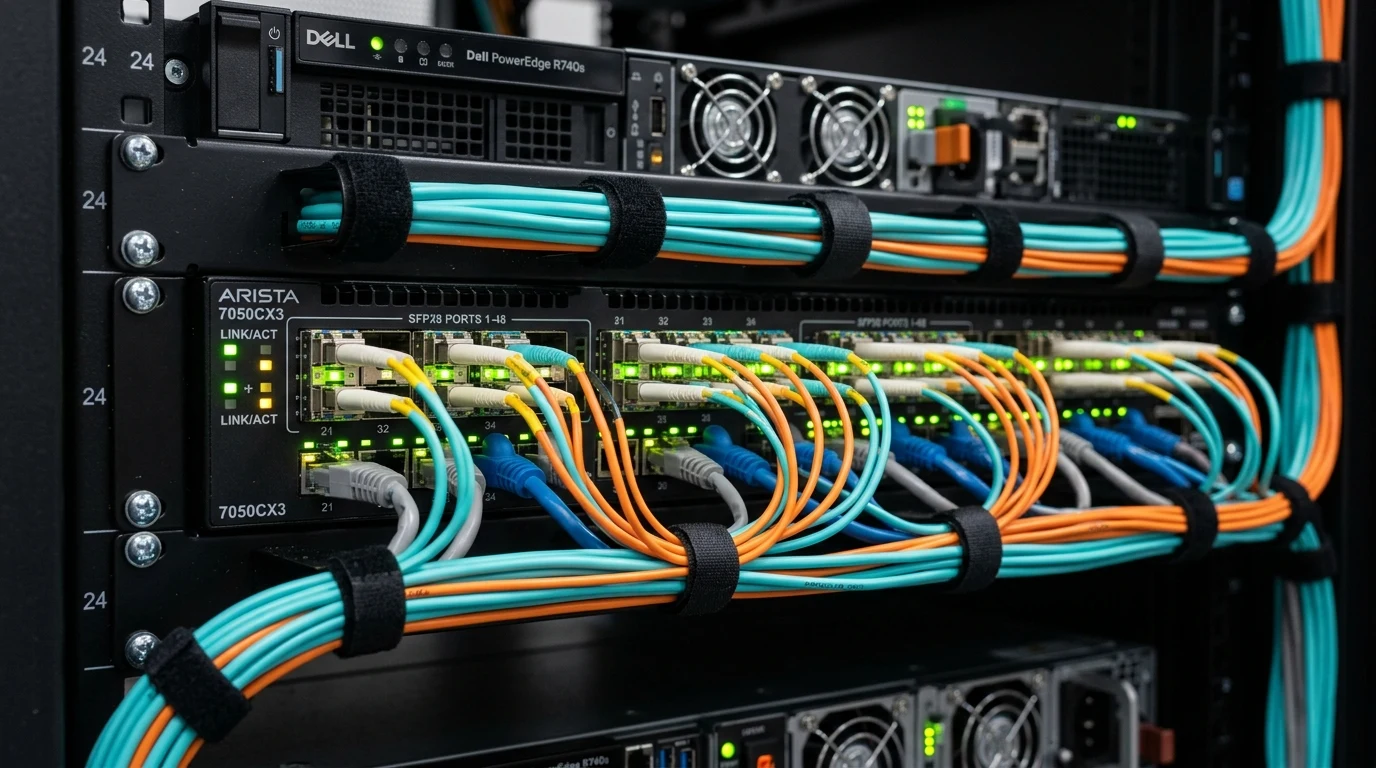
- Bandwidth-to-Cost Efficiency: 25GbE (SFP28) delivers 2.5x the throughput of 10GbE (SFP+) over a single physical lane while incurring only a 15% to 25% switch port cost premium, slashing the cost per gigabit by more than 50%.
- PCIe Lane Optimization: Single-lane 25GbE operates over a single PCIe 3.0/4.0 lane, enabling high-density dual-port 25GbE NICs to run in compact PCIe x4/x8 slots without bottlenecking CPU bus bandwidth.
- Cabling Backward Compatibility: SFP28 ports natively accept standard 10GbE SFP+ transceivers and Direct Attach Copper (DAC) cables, enabling phased, zero-downtime server migration without wholesale network rip-and-replace.
- Storage Network Acceleration: High-throughput NVMe-oF (NVMe over Fabrics) and iSCSI SAN workloads saturate dual 10GbE uplinks under burst loads; 25GbE provides the necessary line-rate headroom to eliminate storage latency queues.
Why Is 25GbE Replacing 10GbE in Modern SMB Datacenters?
25GbE (SFP28) is replacing 10GbE (SFP+) in enterprise data centers because it utilizes a single 25 Gbps electrical lane—matching the native SerDes signaling rate of modern server processors—delivering 250% of the bandwidth of 10GbE at virtually identical power consumption and cable footprint.
For more than a decade, 10 Gigabit Ethernet was the undisputed standard for enterprise server virtualization and top-of-rack (ToR) switching. However, the explosion of high-density virtual machine hosts, all-flash NVMe storage arrays, and private on-premises AI inference workloads has pushed 10GbE interfaces into severe packet queue congestion.
Historically, moving beyond 10GbE required jumping to 40GbE (QSFP+). But 40GbE was an inefficient, expensive architectural hack: it bonded four separate 10Gbps lanes together, requiring thick, expensive quad-lane transceivers and heavy cabling. 25GbE completely redefined datacenter networking by packing 25 Gbps of throughput into a single physical lane using the identical compact SFP form factor.
Technical Specification Comparison: SFP+ vs SFP28 Standards
Understanding the electrical and physical layer differences between 10GbE and 25GbE is essential for planning rack-level power, cooling, and optical cabling runs:
| Architecture Dimension | 10 Gigabit Ethernet (10GbE) | 25 Gigabit Ethernet (25GbE) | TCO & Procurement Impact |
|---|---|---|---|
| Transceiver Form Factor | SFP+ (Enhanced Small Form-Factor) | SFP28 (28 Gbps Signaling Rate) | Identical port size & rack faceplate density |
| Electrical Lanes Required | 1 Lane @ 10.3125 Gbaud | 1 Lane @ 25.78125 Gbaud | 2.5x throughput with zero lane sprawl |
| Direct Attach Copper (DAC) Max Reach | Up to 7 meters (Passive) | Up to 3–5 meters (Passive / RS-FEC) | 25GbE requires active cables beyond 3m |
| Forward Error Correction (FEC) | Optional (Firecode) | Mandatory on Long Runs (RS-FEC / Base-R) | Adds ~80ns to 250ns latency for error check |
| Average Switch Port Cost (Enterprise) | ~$85 – $120 per managed port | ~$110 – $145 per managed port | Cost per Gbps drops from $10/Gb to $4.80/Gb |
| Dual-Port Server NIC Cost | ~$180 – $240 (Intel X520/X710) | ~$240 – $320 (Broadcom / Mellanox) | Negligible premium on modern server builds |
Cost-Per-Gigabit Math: 48-Port Switch Procurement Sizing
To evaluate the real procurement economics for an enterprise server refresh across two server racks (40 dual-homed servers), we compare a traditional 10GbE top-of-rack deployment against a modern 25GbE architecture:
- 10GbE Deployment Model (Dual 48-Port 10GbE Switches):
- 2x Enterprise 48-Port 10GbE SFP+ Switches (with 6x 100GbE uplinks): ~$8,500 each = $17,000.
- 80x 10G SFP+ Passive DAC Cables (2m/3m): $80 imes \$18 = \$1,440.
- 40x Dual-Port 10GbE Server NICs: $40 imes \$210 = \$8,400.
- Total Capital Expenditure: $26,840.
- Total Usable Bandwidth: 800 Gbps aggregate server bandwidth.
- Capital Cost Per Gbps: $33.55 per Gbps.
- 25GbE Deployment Model (Dual 48-Port 25GbE Switches):
- 2x Enterprise 48-Port 25GbE SFP28 Switches (with 6x 100GbE uplinks): ~$11,200 each = $22,400.
- 80x 25G SFP28 Passive DAC Cables (2m/3m): $80 imes \$26 = \$2,080.
- 40x Dual-Port 25GbE Server NICs: $40 imes \$280 = \$11,200.
- Total Capital Expenditure: $35,680.
- Total Usable Bandwidth: 2,000 Gbps aggregate server bandwidth.
- Capital Cost Per Gbps: $17.84 per Gbps.
The financial analysis proves that while the 25GbE deployment costs an additional $8,840 in absolute dollars (+32.9%), it delivers 1,200 Gbps of additional bandwidth (+150%), effectively cutting the cost per gigabit nearly in half from $33.55/Gbps down to $17.84/Gbps.
Direct Attach Copper (DAC) vs Active Optical Cables (AOC) vs SFP28 Optics
Selecting the optimal physical interconnect media within the rack is critical for keeping switch power consumption, thermal load, and cabling budgets under control:
- Passive Direct Attach Copper (DAC) Cables: For in-rack server connections under 3 meters (Top-of-Rack switch to adjacent server chassis), passive twinaxial DAC cables are the gold standard. They consume less than 0.1 Watts of power per port, cost under $25 per cable, and introduce zero transceiver latency (under 5 nanoseconds). Note that while 10GbE DAC cables operate reliably up to 7 meters, 25GbE DAC runs beyond 3 meters require RS-FEC or active boosting.
- Active Optical Cables (AOC) and SFP28-SR Optics: For cross-rack runs, end-of-row aggregation, or connections extending from 3 to 100 meters, SFP28 short-reach multimode (SR) optics or AOC assemblies are required. While SFP28-SR transceivers consume approximately 1.0 to 1.2 Watts per port, they generate dramatically less heat than legacy 10GBASE-T copper RJ45 transceivers, which consume an alarming 2.5 to 3.5 Watts per port and operate at blistering surface temperatures.
Migration Architecture: Step-by-Step Phased Transition from 10GbE
Modern enterprise ToR switches—such as the Dell PowerSwitch S5248F-ON or Cisco Nexus 93180YC-FX3—feature multi-rate SFP28 ports that operate at both 10 Gbps and 25 Gbps. This enables infrastructure teams to execute a non-disruptive, multi-year migration plan:
- Phase 1 (Switch Modernization): Deploy 25GbE ToR switches into the rack and connect existing 10GbE servers directly using legacy 10G SFP+ DACs. The switch ports auto-negotiate to 10G line rate without requiring configuration overhauls.
- Phase 2 (Uplink Aggregation): Connect the new 25GbE ToR switches to the core aggregation layer using 100GbE (QSFP28) uplinks, expanding rack-to-core spine bandwidth from 40G to 400G (via 4x 100G bonded trunks).
- Phase 3 (Server Lifecycle Refresh): As legacy dual-socket servers reach end-of-life and are replaced with high-density EPYC or Xeon compute nodes, order servers with dual-port 25GbE SFP28 PCIe NICs (e.g., Broadcom BCM57414 or Nvidia ConnectX-6 Lx). Upgrade the patch cables to 25G DACs to instantly unlock 2.5x throughput per host.
Procuring 10GbE switches for new enterprise server racks in 2026 is an immediate technical debt trap. Because 25GbE SFP28 ports are natively backward compatible with existing 10G SFP+ optical transceivers, deploying 25GbE top-of-rack switches enables immediate support for legacy 10G equipment while providing an instant 2.5x line-rate upgrade path for modern NVMe-oF storage arrays and virtualization clusters. 25GbE is the mandatory procurement standard for all new enterprise datacenter builds.
For companion infrastructure hardware evaluations, study our architectural analysis on Cisco Meraki vs UniFi Enterprise: Cloud Licensing Math, and review our branch security comparison on Fortinet FortiGate vs SonicWall TZ: Branch Firewall TCO.