
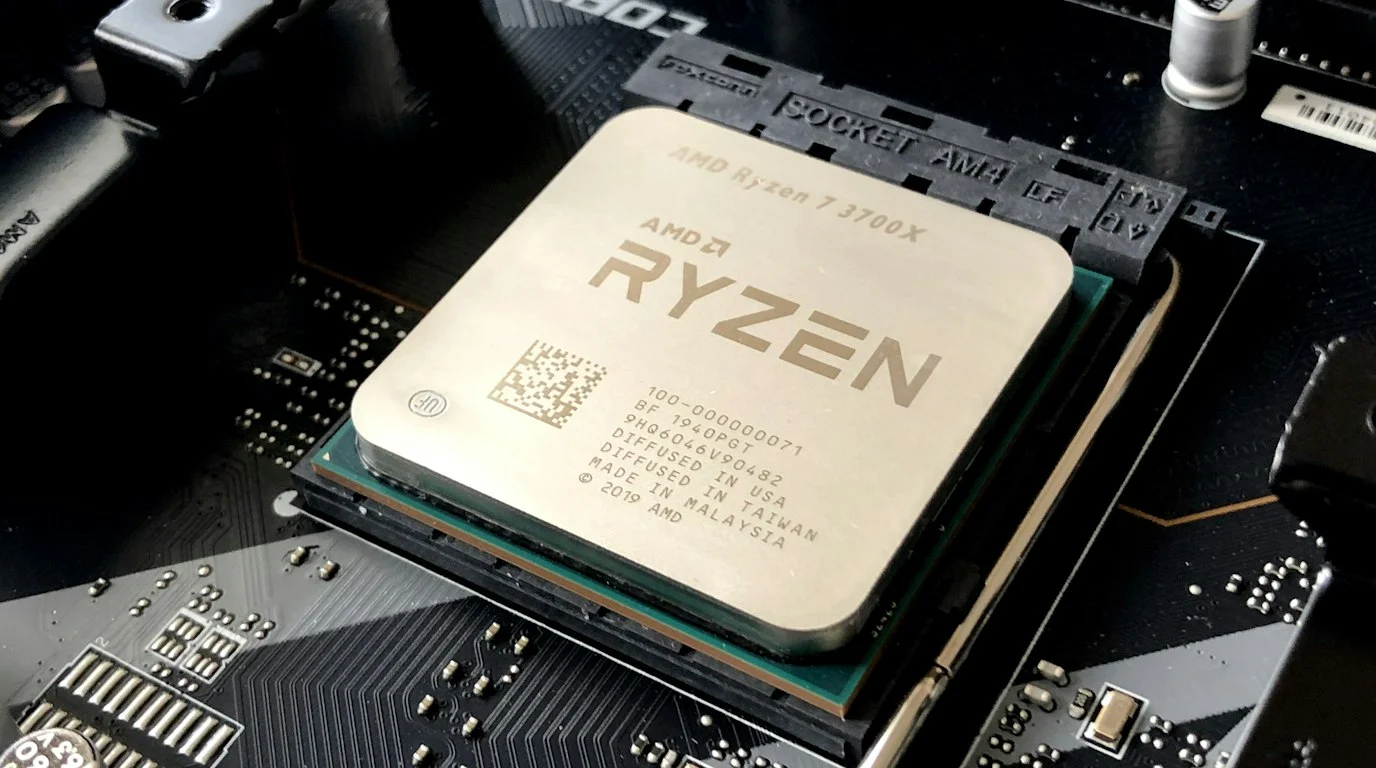
- PCIe Gen 5 Lane Availability: AMD Threadripper Pro 7000WX processors provide an unmatched 128 usable PCIe Gen 5 lanes from the CPU, allowing true x16/x16/x16/x16 quad-GPU saturation alongside direct-attached Gen 5 NVMe storage arrays. Intel Xeon W-3400 offers up to 112 PCIe Gen 5 lanes.
- 8-Channel DDR5 Memory Bandwidth: Both platforms support 8-channel DDR5 ECC Registered RDIMM memory. Threadripper Pro officially supports up to DDR5-5200/5600 speeds, achieving memory bandwidth exceeding 265 GB/s, which is critical for local CPU-offloaded LLM fine-tuning and massive FP8 model weights.
- Zen 4 vs. Golden Cove IPC & Efficiency: AMD’s TSMC 5nm Zen 4 architecture delivers vastly superior compute density (up to 96 cores / 192 threads on the 7995WX) and dramatically lower power draw under continuous AI training loads compared to Intel’s Intel 7 process on the Xeon W9-3495X (56 cores).
- Workstation Platform TCO: While AMD processors carry a higher initial CPU MSRP, Intel Xeon W platforms require massive 1,600W–2,000W redundant power supplies, aggressive custom liquid cooling to prevent thermal throttling, and costlier VRM motherboards, bringing total workstation platform TCO to near parity.
In enterprise artificial intelligence (AI) research, quantitative finance, and autonomous engineering labs, the demand for on-premises, secure AI workstations has exploded. Organizations handling proprietary clinical trial data, confidential financial ledgers, or trade-secret algorithmic codebases cannot risk transmitting raw datasets to public cloud API endpoints like OpenAI or Anthropic. Instead, enterprise engineers are deploying on-premises private AI workstations to execute local Large Language Model (LLM) fine-tuning (using LoRA/QLoRA), high-throughput batch inference (via vLLM/SGLang), and complex synthetic simulation.
When engineering high-end multi-GPU AI workstations, consumer desktop platforms (such as Intel Core i9 or AMD Ryzen) fail immediately due to severely restricted PCIe lane budgets (typically only 16 to 24 lanes) and dual-channel memory limitations. Enterprise AI workstations require dedicated workstation silicon capable of saturating multiple NVIDIA RTX 6000 Ada Generation or dual RTX 4090/5090 accelerators while providing terabytes of ECC memory. This technical showdown models the architectural capabilities, thermal dynamics, memory bandwidth, and procurement TCO of AMD Ryzen Threadripper Pro 7000WX versus Intel Xeon W-3400.
Which Processor Platform Is Superior for Enterprise AI Workstations?
Direct Answer: AMD Threadripper Pro 7000WX is the definitive leader for enterprise AI workstations. AMD offers up to 96 cores (versus Intel’s 56), 128 PCIe Gen 5 lanes for unrestricted quad-GPU bandwidth, superior power efficiency, and faster native DDR5 memory support, eliminating data starvation bottlenecks during heavy multi-GPU local LLM training.
The core bottleneck in enterprise AI workstations is not merely CPU clock speed; it is I/O bandwidth and memory capacity. Modern generative AI models—such as Llama-3-70B, DeepSeek-R1, and Mistral Large—require massive memory footprints. When fine-tuning these models using multiple GPUs, data must flow between the CPU host memory, high-speed NVMe scratch disks, and GPU VRAM across the PCI Express bus at microsecond latencies.
AMD’s Threadripper Pro 7000WX platform (built on the sTR5 socket and WRX90 chipset) provides 128 PCIe Gen 5 lanes directly from the CPU. This expansive lane allocation allows system builders to configure four full-bandwidth PCIe Gen 5 x16 slots for four high-end enterprise GPUs, while still retaining 64 remaining Gen 5 lanes for quad-NVMe RAID AIC cards (supporting 50+ GB/s scratch storage) and dual 100GbE RoCEv2 network adapters without any chipset DMI bottlenecking.
Intel’s Xeon W-3400 platform (socket LGA-4677 and W790 chipset) provides up to 112 PCIe Gen 5 lanes on top-tier “Expert” SKUs (such as the Xeon W9-3495X and W7-3465X). While 112 lanes easily accommodate three or four GPUs, configuring redundant enterprise NVMe storage arrays requires compromising slot bandwidth or dropping GPU interfaces to x8 electrical links.
| Architecture Dimension | AMD Threadripper Pro 7975WX / 7985WX | Intel Xeon W9-3495X / W7-3465X | Enterprise AI Workstation Impact |
|---|---|---|---|
| Max Core / Thread Density | Up to 96 Cores / 192 Threads (7995WX) | Up to 56 Cores / 112 Threads (W9-3495X) | AMD delivers 71% higher multi-threaded compute density |
| PCIe Gen 5 Lane Budget | 128 Lanes (Direct from CPU) | 112 Lanes (Direct from CPU) | AMD enables quad x16 GPUs + dual x16 NVMe RAID cards |
| Memory Channels & Speed | 8-Channel DDR5-5200/5600 ECC RDIMM | 8-Channel DDR5-4800 ECC RDIMM | AMD achieves ~265 GB/s host memory bandwidth; Intel peaks at ~230 GB/s |
| Manufacturing Process & Efficiency | TSMC 5nm Compute + 6nm I/O Die | Intel 7 (10nm Enhanced SuperFin) | AMD runs vastly cooler; Intel draws 500W+ under full CPU load |
| Matrix & AI Instruction Sets | AVX-512 (Native 512-bit FMA pipelines) | Intel AMX (Advanced Matrix Extensions) | Intel AMX provides fast CPU-only INT8/BF16 inference; AMD dominates multi-GPU |
8-Channel DDR5 Memory Bandwidth and LLM Offloading
One of the most revolutionary advances in enterprise local AI is hybrid CPU/GPU model offloading (facilitated by frameworks like KTransformers, llama.cpp, and vLLM). When organizations run ultra-large models like DeepSeek-R1 (671B parameters) or 405B dense models, fitting the entire parameter weight set into GPU VRAM requires $80,000+ in enterprise graphics hardware. However, with hybrid offloading, active attention layers are cached in GPU VRAM while inactive Mixture-of-Experts (MoE) weights remain resident in host system RAM.
In this workflow, the CPU host memory bandwidth becomes the primary performance bottleneck. Both Threadripper Pro 7000WX and Xeon W-3400 utilize an 8-channel DDR5 ECC RDIMM memory bus. When populated with eight high-density DDR5-5600 RDIMMs, AMD Threadripper Pro delivers sustained memory bandwidth exceeding 265 GB/s. By contrast, Intel Xeon W-3400 tops out around 230 GB/s on DDR5-4800.
This 15% memory throughput advantage translates directly into higher tokens-per-second generation speeds during local AI inference. Furthermore, AMD’s full support for AVX-512 instructions—implemented using a native 512-bit data path without frequency downclocking—ensures that CPU-bound vector math operations execute at maximum clock speeds without throttling.
Thermal Engineering, VRM Demands, and Workstation Acoustic Limits
A critical operational consideration often overlooked in procurement is office thermal and acoustic limits. Enterprise AI workstations rarely reside in dedicated datacenter server rooms; they are deployed under desks in corporate engineering offices, medical laboratories, and financial trading floors where noise levels must remain below 45 dB.
Intel’s Xeon W-3400 processors, manufactured on the Intel 7 process, suffer from extreme power draw. Under heavy sustained multi-threaded compilation or CPU matrix multiplication, the Xeon W9-3495X regularly consumes 450W to 550W of power on the CPU package alone. Dissipating this thermal load requires massive custom liquid cooling loops with 360mm/420mm radiators and high-RPM fans, or server-style blower fans that produce intolerable acoustic noise in an office environment.
AMD’s Threadripper Pro processors, manufactured on TSMC’s advanced 5nm node, demonstrate remarkable energy efficiency. The 32-core Threadripper Pro 7975WX and 64-core 7985WX deliver higher IPC performance while maintaining a standard 350W TDP. High-end air coolers (such as the Noctua NH-U14S TR5-SP6) can effectively cool Threadripper Pro under continuous 24/7 AI workloads with near-silent acoustics, eliminating the risk of coolant leaks and pump failures inherent in liquid-cooled workstations.
For enterprise engineering teams building dedicated on-premises AI workstations, AMD Threadripper Pro 7000WX (specifically the 7975WX or 7985WX) is the undisputed champion. Its 128 PCIe Gen 5 lanes allow full-speed multi-GPU scaling without lane starvation, its 8-channel DDR5-5600 memory architecture eliminates host offloading bottlenecks, and its superior 5nm power efficiency allows silent, stable air cooling directly in office environments. Intel Xeon W-3400 remains viable only for legacy enterprise software stacks that explicitly require Intel AMX matrix acceleration for CPU-only inference, but for modern GPU-accelerated AI pipelines, AMD represents the definitive workstation investment.