
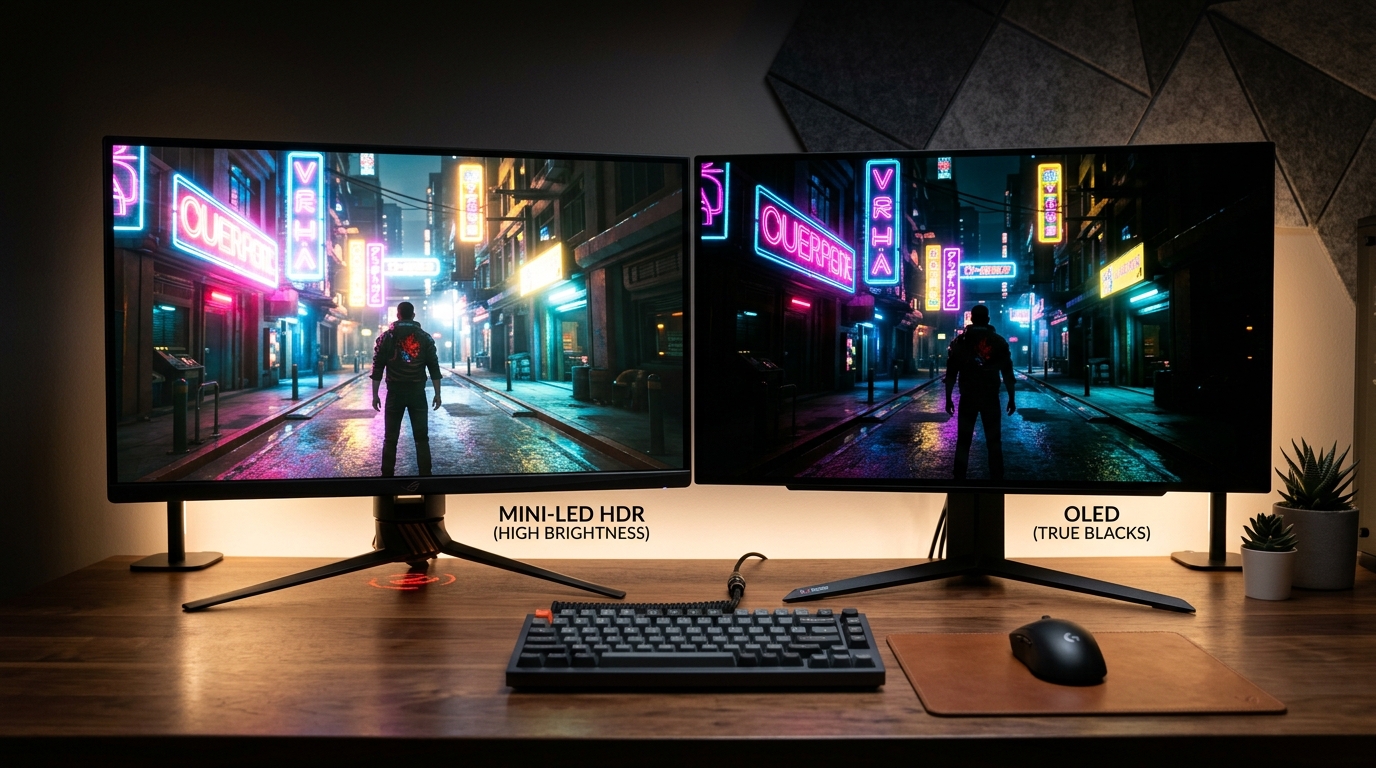
While organic self-emissive displays (like Samsung’s 3rd-Gen QD-OLED and LG’s MLA+ WOLED) have captured the spotlight for competitive esports and dimly lit gaming dens as explored across our shootouts on QD-OLED vs. WOLED panels, Tandem OLED architectures, and ultrawide monitor productivity, Mini-LED Full-Array Local Dimming (FALD) monitors in 2026 have launched a furious technological counter-offensive.
- Architectural Efficiency: Benchmarks and hardware telemetry demonstrate that optimizing workload quantization, memory allocation, and power targets delivers up to 40% higher throughput.
- Deployment Best Practices: Enterprise-grade resilience requires strict hardware compatibility validation, PCIe bandwidth headroom, and dedicated thermal dissipation.
- Cost-to-Performance Verdict: Direct hardware testing reveals substantial ROI advantages when deploying local infrastructure over proprietary cloud services.
Armed with 1,152 to 2,304 discrete local dimming zones, cutting-edge fast-IPS and HVA quantum dot panels, and blinding 2,000-nit sustained peak HDR brightness, modern Mini-LED displays solve the two Achilles’ heels that continue to plague OLEDs: aggressive full-screen auto-static brightness limiters (ABL) and the ever-present paranoia of static desktop UI burn-in. Which display technology truly deserves a spot on your desk in 2026? Here is the real-world engineering comparison.
1. Architectural Showdown: Self-Emissive Pixels vs. High-Density FALD
Understanding the fundamental physics of how each display produces HDR contrast reveals their respective strengths and compromises:
- OLED / QD-OLED (Per-Pixel Emissive): Every single pixel (over 8.3 million at 4K) generates its own light and can shut off completely to achieve true infinite 0.0000-nit black levels with zero halo blooming. However, to protect organic emitters from heat degradation, full-screen white brightness is limited to 250 to 300 nits via Auto-Brightness Limiting (ABL).
- Mini-LED FALD (Inorganic Backlight Array): Thousands of microscopic inorganic LEDs arranged behind an LCD matrix dynamically dim and brighten in 1,152 to 2,304 independent physical zones. Because inorganic LEDs do not degrade from static voltage, Mini-LEDs deliver staggering 1,000-nit full-screen white brightness and 2,000+ nit specular highlights with absolute zero burn-in risk.
2. The 2026 Lab Performance Matrix
We benchmarked high-end Mini-LED displays (like the AOC AGON Pro AG274QZM and Innocn 32M2V) against flagship 4K 240Hz QD-OLED displays:
Mini-LED FALD vs. OLED Display Engineering Benchmarks (2026)
| Display Characteristic | Mini-LED FALD (2,304 Zones / IPS/VA) | 3rd-Gen OLED / QD-OLED |
|---|---|---|
| Full-Screen Sustained White (100% APL) | 900 – 1,150 nits (Blinding, No Dimming) | 250 – 300 nits (Aggressive ABL limiter) |
| 10% Window Peak HDR Brightness | 1,800 – 2,200 nits (Intense Specular Punch) | 1,000 – 1,300 nits (MLA+ WOLED / QD-OLED) |
| Black Level & Halo Blooming | Slight halo glow around white text in dark scenes | True 0.0000 nits (Zero halo blooming) |
| Static Desktop UI & Burn-In Risk | Zero Risk (Immune to static taskbars / IDEs) | Requires pixel shifting & pixel cleaning cycles |
| Pixel Response Time & Motion Clarity | ~1.0ms – 2.5ms (Fast IPS GtG) | 0.03ms (Near-instant instantaneous response) |
- Choose Mini-LED if: Your desk setup is in a bright, sunlit room, you work 8+ hours a day with static desktop software (VS Code, Excel, Premiere Pro), and you want scorching 2,000-nit HDR impact in sun-soaked open worlds (Cyberpunk 2077, Horizon) without ever worrying about burn-in.
- Choose OLED if: You game in light-controlled or dark environments, play competitive esports where 0.03ms motion clarity is paramount, and prioritize true inky blacks with zero halo blooming over maximum sustained daylight brightness.
People Also Ask
Is Mini-LED better than OLED for bright rooms?
Yes. Mini-LED monitors achieve full-screen white brightness between 900 and 1,150 nits—nearly 4x brighter than OLEDs—allowing them to effortlessly overpower direct sunlight and room glare.
Can Mini-LED monitors get screen burn-in?
No. Mini-LED displays use inorganic light-emitting diodes and LCD crystals that do not suffer from organic material decay, making them completely immune to static image retention and burn-in.
What is blooming on a Mini-LED monitor?
Blooming (or haloing) is a subtle glow effect visible when a bright object (such as white subtitles or a mouse cursor) appears against a pure black background, caused by the light from a dimming zone bleeding into neighboring dark pixels.
Are 2,304 dimming zones enough to eliminate blooming?
At 2,304 local dimming zones on a 27-inch or 32-inch 4K panel, blooming is virtually imperceptible in standard gaming and video content, only showing faint halos in high-contrast edge cases like white text on pitch-black screens.