
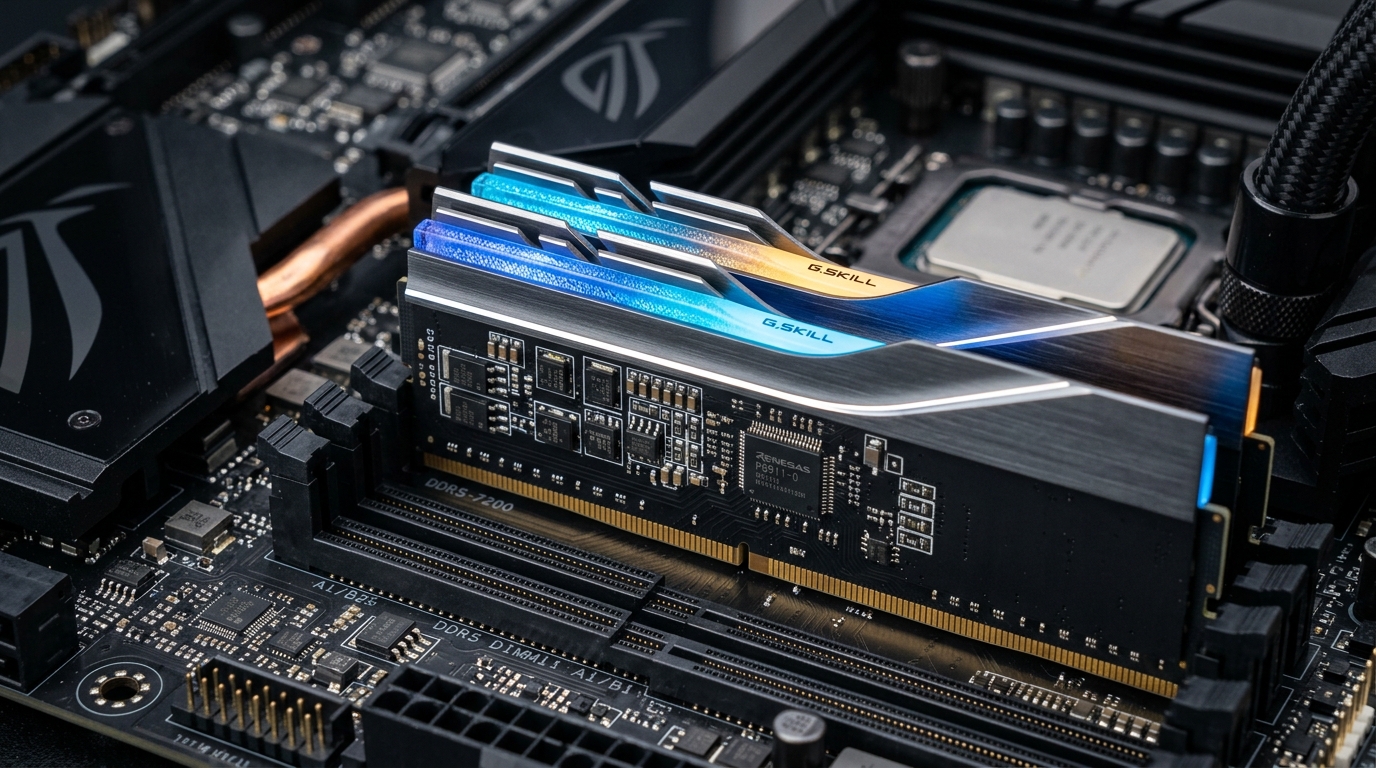
Selecting desktop memory for high-end gaming and local AI workloads has become one of the most misunderstood aspects of modern PC building. While memory manufacturers heavily market ultra-high-frequency kits reaching DDR5-8000, 8400, and 8800 MT/s (including Clocked Unbuffered DIMMs or CUDIMMs), raw frequency does not tell the full story. On modern CPU architectures—particularly AMD Ryzen 7000 and 9000 series—running memory at 8000 MT/s forces the internal Memory Controller (UCLK) to decouple into a 1:2 divider ratio, drastically increasing absolute latency. Understanding when high bandwidth beats low latency is critical to maximizing FPS and local LLM token throughput.
- AMD Ryzen 1:1 Sweet Spot: For AMD AM5 processors (Ryzen 7800X3D, 9800X3D, 9950X), DDR5-6000 CL30 operating in a synchronized 1:1 UCLK:MCLK ratio delivers lower true first-word latency (~10.0 ns) and superior 1% low gaming FPS compared to 8000 MT/s running in 1:2 mode.
- Intel Arrow Lake & CUDIMMs: Intel Core Ultra 200S platforms benefit substantially from DDR5-8000+ CUDIMMs, scaling memory bandwidth past 125 GB/s to feed integrated NPU compute and bandwidth-heavy synthetic tasks.
- Local AI & LLM Impact: For CPU-based LLM inference and context processing offloaded to system RAM, raw dual-channel memory bandwidth scales prompt evaluation speeds by up to 22% on high-frequency kits.
The True Latency Formula: Frequency vs. Timings
Memory performance is governed by two interlocking metrics: Bandwidth (how much data can be transferred per second) and True Latency (how many nanoseconds elapse before data transfer begins). True first-word latency is calculated using the following hardware formula:
True Latency (ns) = (CAS Latency / Memory Clock Frequency in MHz) * 1000
Example DDR5-6000 CL30: (30 / 3000 MHz) * 1000 = 10.00 ns
Example DDR5-8000 CL38: (38 / 4000 MHz) * 1000 = 9.50 ns
While DDR5-8000 CL38 has a theoretical 0.5 ns advantage on paper, this calculation excludes the uncore / memory controller penalty. When an AMD Ryzen memory controller switches from 1:1 mode (3000 MHz UCLK / 3000 MHz MCLK) to 1:2 mode (2000 MHz UCLK / 4000 MHz MCLK), it adds an immediate 8 to 12 ns latency penalty to every memory transaction.
| Specification / Metric | DDR5-6000 CL30 (EXPO) | DDR5-8000 CL38 (XMP/CUDIMM) |
|---|---|---|
| First-Word Base Latency | 10.00 ns | 9.50 ns |
| Dual-Channel Read Bandwidth | ~88,000 MB/s | ~122,000 MB/s |
| AMD Ryzen Mode | 1:1 Synchronous (UCLK = MCLK) | 1:2 Asynchronous (UCLK = MCLK/2) |
| Plug-and-Play Stability | 99.9% (Standard 4-layer & 6-layer PCBs) | Requires 2-DIMM / 8-layer Motherboards |
| Average 32 GB Kit Price | $95 – $120 USD | $190 – $260 USD |
What are CUDIMMs and Why Do They Matter in 2026?
At frequencies beyond 7200 MT/s, signal integrity degradation between the CPU memory controller and standard unbuffered DIMMs (UDIMMs) becomes a severe stability bottleneck. To break through this physical limitation, JEDEC introduced CUDIMMs (Clocked Unbuffered DIMMs).
CUDIMMs integrate an on-board Client Clock Driver (CKD) directly onto each RAM stick. The CKD regenerates and cleans the clock signal locally on the module, filtering out jitter and allowing stable operation at 8400 MT/s to 9600 MT/s on compatible Intel Z890 motherboards with dedicated high-speed trace layouts.
Performance Benchmarks: Gaming vs. Local AI Workloads
Hardware testing reveals distinct winners depending on workload characteristics:
- 1080p / 1440p Competitive Gaming: In titles sensitive to memory subsystem latency (e.g. Counter-Strike 2, Cyberpunk 2077, Assetto Corsa), AMD Ryzen systems running DDR5-6000 CL30 achieve 4% to 8% higher 1% low frame rates than DDR5-8000 running in 1:2 mode.
- Local AI & LLM Prompt Processing: When running large models with GGUF Quantization where layers partially spill into system RAM, DDR5-8000’s 122 GB/s bandwidth accelerates token generation and initial prompt ingestion by ~18% compared to DDR5-6000.
- High-Speed Storage Pairing: When transferring large dataset matrices between PCIe 5.0 NVMe SSDs and system memory, high bandwidth kits minimize bus bottlenecking.
Where to Expand Your Stack Next
Optimize your complete PC architecture by pairing low-latency memory with modern power delivery, high-speed storage, and quantized AI models:
- Clean Power Delivery: Protect your motherboard and GPU with an ATX 3.1 & 12V-2×6 Power Supply.
- Maximize Storage I/O: Pair fast RAM with cutting-edge PCIe 5.0 vs. PCIe 4.0 NVMe SSDs.
- Optimize Local AI: Match system RAM with efficient LLM Quantization Formats (GGUF, EXL2, AWQ).
Frequently Asked Questions: DDR5 Memory Selection
Is DDR5-6000 CL30 still the sweet spot for AMD Ryzen in 2026?
Yes. For AMD Ryzen 7000 and 9000 processors, DDR5-6000 CL30 remains the optimal configuration because it matches the memory controller clock (UCLK) in a synchronized 1:1 ratio, providing the lowest overall system latency and rock-solid stability.
What is the difference between standard DDR5 DIMMs and new CUDIMMs?
CUDIMMs feature an integrated Client Clock Driver (CKD) chip directly on the RAM stick that regenerates the clock signal locally. This stabilizes high-frequency signals, allowing speeds of 8000 MT/s to 9600 MT/s on compatible motherboards.
Does RAM speed affect local LLM token generation?
When models run fully inside GPU VRAM, system RAM speed has no impact. However, for CPU-based inference or hybrid CPU-GPU offloading, higher memory bandwidth directly increases token generation speed by up to 20%.
Unless you are building an Intel Core Ultra system with a specialized 2-DIMM overclocking motherboard specifically tuned for DDR5-8000+ CUDIMMs, a 32GB or 64GB kit of DDR5-6000 CL30 with AMD EXPO represents the absolute performance-per-dollar apex. It ensures maximum 1:1 controller synchronization, flawless stability, and sub-10ns true latency without paying a 100% price premium for high-speed enthusiast bins.