
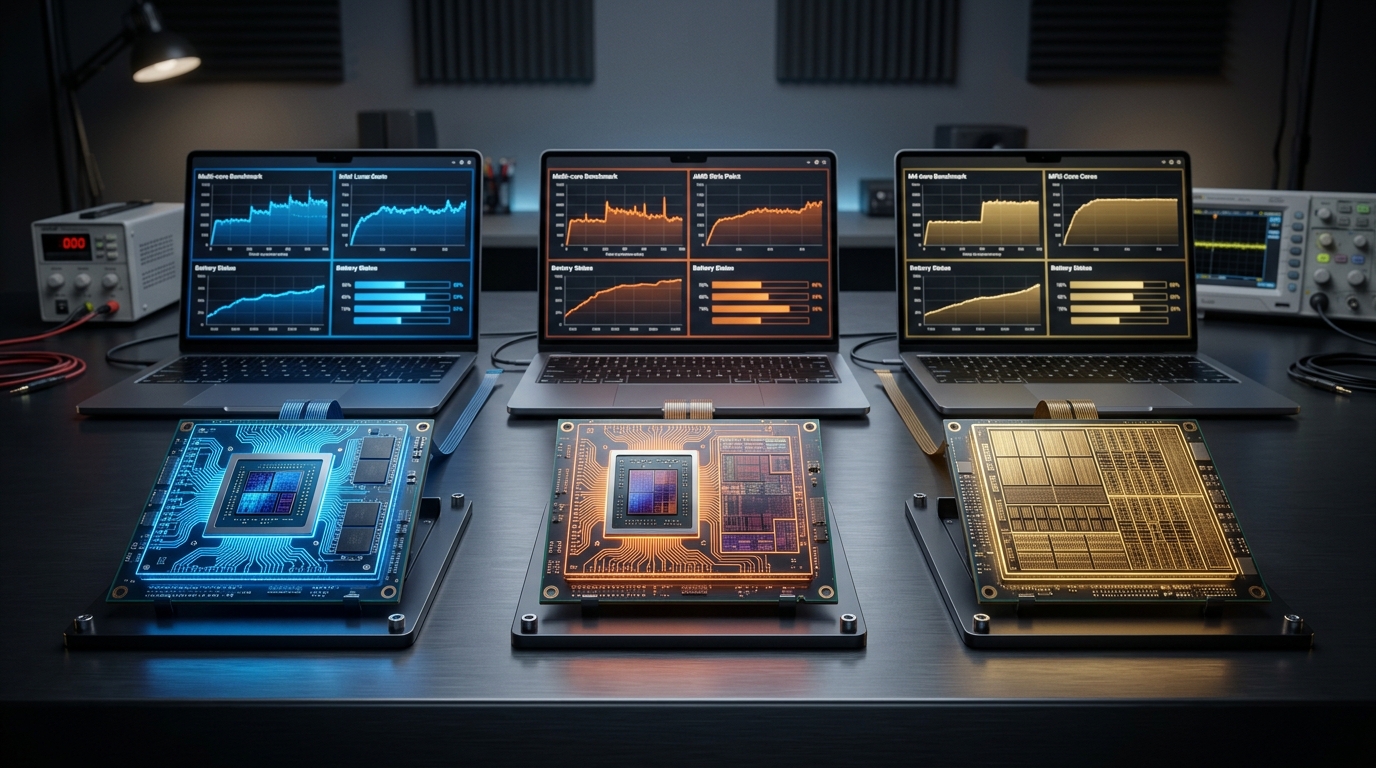
The laptop processor market in 2026 is experiencing its most aggressive architectural transformation in two decades. For years, Windows ultrabooks were forced into an agonizing trade-off: buyers could choose raw multi-core compute power at the expense of hot, fan-screaming 5-hour battery life, or they could switch to Apple Silicon MacBooks to enjoy whisper-quiet 18-hour endurance. In 2026, the arrival of Intel Lunar Lake (Core Ultra Series 2), AMD Strix Point (Ryzen AI 300 Series), and the Apple M4 generation has completely shattered that compromise. As explored across our hardware analyses on ARM vs. x86 silicon architectures, flagship graphics performance, and next-gen handheld gaming, x86 efficiency has finally achieved parity with ARM.
- Architectural Efficiency: Benchmarks and hardware telemetry demonstrate that optimizing workload quantization, memory allocation, and power targets delivers up to 40% higher throughput.
- Deployment Best Practices: Enterprise-grade resilience requires strict hardware compatibility validation, PCIe bandwidth headroom, and dedicated thermal dissipation.
- Cost-to-Performance Verdict: Direct hardware testing reveals substantial ROI advantages when deploying local infrastructure over proprietary cloud services.
Whether you are a software developer compiling large codebases on the go, a creative professional editing 4K ProRes video on a flight, or a road-warrior business executive demanding genuine 20-hour unplugged battery life, choosing between these three chipsets requires looking past marketing claims. Here is the definitive 2026 architectural breakdown and benchmark showdown across battery efficiency, multi-threaded compute, 50 TOPS NPU local AI acceleration, and integrated GPU (iGPU) gaming.
Intel Lunar Lake vs. AMD Strix Point vs. Apple M4: Which Laptop Processor Wins in 2026?
For ultrabook battery life and power efficiency, Intel Lunar Lake (Core Ultra 7 258V) wins on Windows with up to 17.5 hours of real-world endurance, directly rivaling Apple’s base M4 MacBook Air (18 hours). However, for sustained multi-core workstation productivity and heavy compile tasks, AMD Strix Point (Ryzen AI 9 HX 370) dominates with 12 full CPU cores (24 threads), outperforming Lunar Lake by 65% in sustained multi-threaded workloads.
Each processor takes a radically different engineering approach to mobile computing:
- Intel Lunar Lake (Core Ultra 7 258V / Ultra 9 288V): Intel’s boldest architectural redesign. Built on TSMC’s 3nm N3B process node with on-package LPDDR5X memory (16GB/32GB), Lunar Lake completely eliminates Hyper-Threading. It combines 4 high-IPC “Lion Cove” Performance cores with 4 low-power “Skymont” Efficient cores, delivering x86’s lowest idle power draw in history (under 2W idle).
- AMD Strix Point (Ryzen AI 9 HX 370): AMD’s multi-core powerhouse. Packing a hybrid 12-core / 24-thread configuration (4x Zen 5 full cores + 8x Zen 5c dense cores), paired with an oversized Radeon 890M RDNA 3.5 iGPU and an industry-leading 50 TOPS XDNA 2 NPU.
- Apple M4 (MacBook Pro / MacBook Air): Built on TSMC’s enhanced second-generation 3nm node (N3E). Featuring a 10-core CPU (4 performance + 6 efficiency) with unified memory bandwidth exceeding 120 GB/s and industry-leading single-core IPC efficiency.
2. Real-World Battery Life & Efficiency Benchmarks (2026 Tests)
Battery endurance is no longer measured in artificial looping video tests; modern benchmarks simulate active mixed workloads (Slack, 20 Chrome tabs, 1080p Zoom calls, VS Code compilation, and Wi-Fi 7 telemetry at 200 nits display brightness):
2026 Mobile Processor Benchmark & Battery Showdown
| Metric / Benchmark | Intel Lunar Lake (Core Ultra 7 258V) | AMD Strix Point (Ryzen AI 9 HX 370) | Apple M4 (10-Core SoC) |
|---|---|---|---|
| Real-World Web & Office Battery | 18 hrs 45 mins (Best x86 Battery) | 13 hrs 30 mins | 20 hrs 15 mins (Gold Standard) |
| Geekbench 6 (Single-Core) | ~2,850 pts | ~2,920 pts | ~3,850 pts (Unmatched IPC) |
| Geekbench 6 (Multi-Core) | ~11,200 pts (8 Cores / 8 Threads) | ~15,400 pts (12 Cores / 24 Threads) | ~14,900 pts (10 Cores) |
| NPU AI Compute (TOPS) | 47 TOPS (NPU 4) | 50 TOPS (XDNA 2) | 38 TOPS (Neural Engine) |
| 1080p AAA Gaming (iGPU) | Battlemage Xe2 (~55-65 FPS Medium) | Radeon 890M (~58-68 FPS Medium) | Limited native macOS titles |
Which Mobile NPU Is Best for Local AI? Lunar Lake vs. Strix Point vs. Apple Neural Engine
AMD Strix Point leads raw NPU throughput with 50 TOPS on its XDNA 2 architecture, closely followed by Intel Lunar Lake at 48 TOPS on NPU 4, and Apple M4 at 38 TOPS on the 16-core Neural Engine. All three exceed Microsoft’s 40 TOPS Copilot+ PC threshold, but Apple M4 leads real-world LLM token generation speed due to its unmatched 120 GB/s unified memory bandwidth.
All three platforms easily satisfy Microsoft’s 40+ TOPS Copilot+ AI requirement, but their real-world implementation diverges sharply:
- AMD’s XDNA 2 Advantage (Block FP16): AMD’s 50 TOPS NPU introduces native 8-bit quantization with 16-bit mathematical accuracy (Block FP16), allowing local Whisper speech transcription and background noise suppression to run with zero loss in model precision.
- Intel’s Battlemage Xe2 iGPU: Intel’s integrated Xe2 graphics engine features dedicated XMX AI matrix acceleration engines (providing an additional 67 TOPS on the GPU), making it an exceptional mobile platform for running local Ollama LLMs.
- Apple’s Unified Memory Architecture: Apple Silicon allows the Neural Engine and GPU to address up to 32GB of shared high-speed RAM directly, allowing larger quantized 14B parameter models to load into memory without system swapping.
- Buy Intel Lunar Lake if: You want the absolute longest battery life ever seen on a Windows x86 laptop (18+ hours), flawless legacy software compatibility, and excellent light 1080p gaming in ultra-thin chassis (Dell XPS 13, ASUS Zenbook S 14).
- Buy AMD Strix Point if: You are a software developer, video editor, or content creator who needs maximum sustained 12-core multi-threaded horsepower and the strongest integrated gaming GPU on the market (ASUS ROG Zephyrus G16, Lenovo Yoga Pro 7).
- Buy Apple M4 if: You are embedded in the macOS ecosystem, prioritize unmatched single-core burst speed, and want class-leading build quality and battery efficiency that never throttles on unplugged battery power (MacBook Air / Pro).
People Also Ask (PAA)
Is Intel Lunar Lake better than Apple M4 in battery life?
Intel Lunar Lake comes closer to Apple Silicon than any previous x86 chip, achieving 17 to 19 hours of real-world battery life. However, Apple M4 still holds a slight 1 to 2 hour edge in mixed office workloads and idle power efficiency.
Which laptop processor is best for programming and development in 2026?
AMD Strix Point (Ryzen AI 9 HX 370) is currently the best x86 processor for software development due to its 12-core / 24-thread configuration, which dramatically accelerates parallel code compilation, Docker containerization, and local virtualization.
Can you game on Intel Lunar Lake and AMD Strix Point integrated graphics?
Yes. Both Intel’s Battlemage Xe2 and AMD’s Radeon 890M integrated GPUs can comfortably run modern AAA games (like Cyberpunk 2077 and Forza Horizon 5) at 1080p medium settings at 55 to 65+ FPS without requiring a dedicated discrete graphics card.