
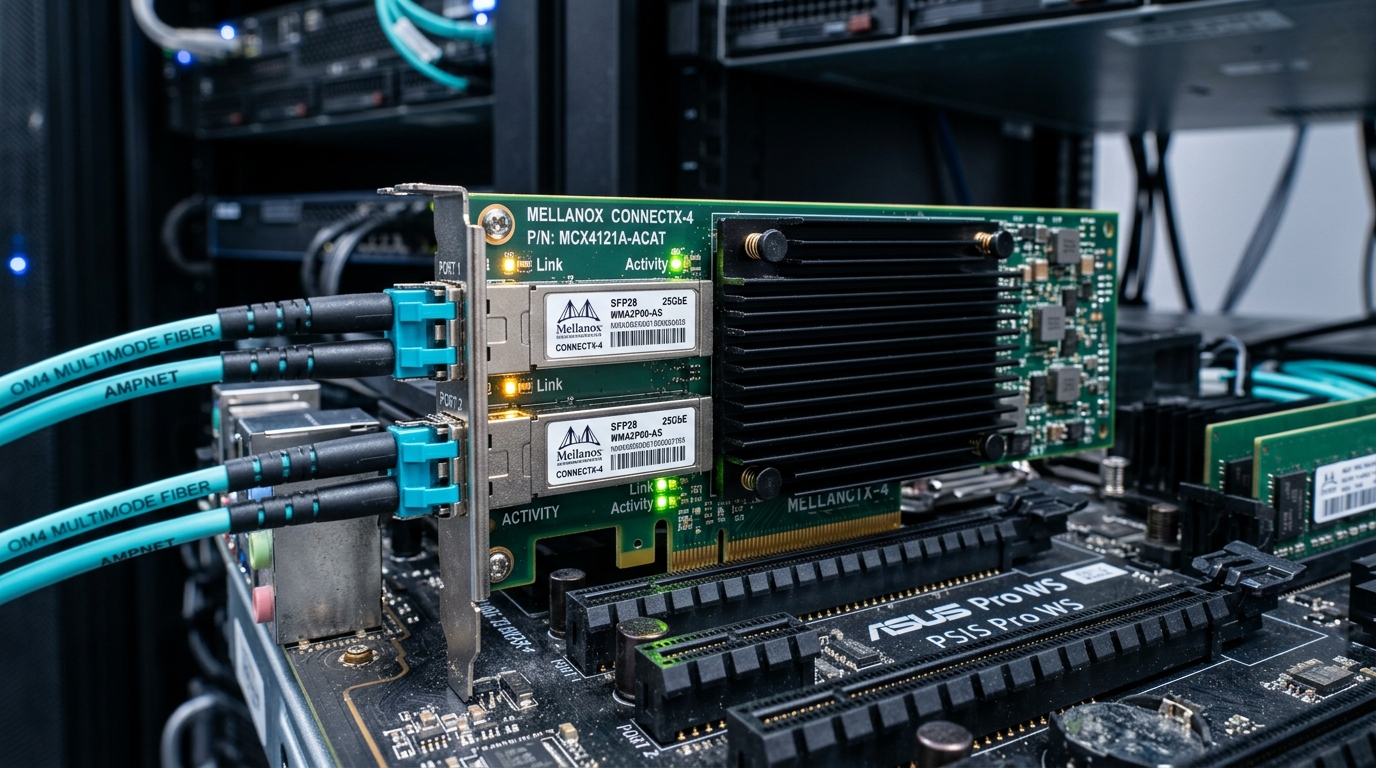
For home lab engineers, Proxmox VE cluster builders, and TrueNAS storage architects upgrading beyond gigabit networking in 2026, the secondary enterprise market offers two dominant contenders: the ubiquitous Intel X520-DA2 (10GbE SFP+) and the increasingly affordable Mellanox ConnectX-4 Lx (25GbE/10GbE SFP28). While an eBay Intel X520 costs approximately $25 and provides reliable 10Gbps connectivity, the Mellanox ConnectX-4 Lx ($45 to $60) delivers 2.5x the line rate, native RoCEv2 (RDMA over Converged Ethernet) hardware offloads, full PCIe ASPM C-state support for sub-15W host idling, and complete driver integration in modern Linux 6.8+ kernels without vendor-locked optic restrictions.
- Bandwidth Headroom: The Mellanox ConnectX-4 Lx operates at 25Gbps (SFP28) while remaining 100% backward-compatible with 10Gbps SFP+ optics and DACs. The Intel X520 is strictly limited to 10Gbps.
- C-State & Idle Power Penalty: The Intel X520 (82599EB controller) does not support modern PCIe Active State Power Management (ASPM L1). Installing an X520 permanently locks modern Intel 12th–14th Gen and AMD CPUs to C2/C3 power states, adding 12W to 18W of parasitic system idle draw. ConnectX-4 Lx allows package C-states down to C8.
- Transceiver Vendor Locking: The Intel X520 rejects non-Intel transceivers by default unless overridden via kernel boot arguments (
ixgbe.allow_unsupported_sfp=1). Mellanox cards natively accept all third-party optical modules, FS.com transceivers, and DAC cables without warning flags.
Hardware Architecture & Technical Specification Matrix
Understanding the hardware architecture explains why the price delta between these cards is negligible compared to the operational advantages in modern hypervisors:
| Architectural Feature | Intel X520-DA2 | Mellanox ConnectX-4 Lx (MCX4121A) | Impact on Proxmox / TrueNAS |
|---|---|---|---|
| Maximum Link Speed | 10 Gbps (SFP+) | 25 Gbps (SFP28) / 10 Gbps (SFP+) | ConnectX-4 yields 2.5x throughput for NVMe-oF & Ceph replication |
| Host Bus Interface | PCIe 2.0 x8 (5.0 GT/s) | PCIe 3.0 x8 (8.0 GT/s) | PCIe 2.0 requires physical x8 electrical slot; ConnectX-4 runs full speed in x4 slot |
| ASPM & Package C-States | Unsupported (Blocks C3+) | Full ASPM L0s / L1 (Reaches C8+) | Saves $25 to $40/year per node in residential 24/7 electrical costs |
| RDMA Hardware Offloads | None (CPU TCP/IP overhead) | RoCEv1, RoCEv2, iWARP | Zero-copy kernel bypass; sub-2µs latency for distributed storage |
| SR-IOV Virtual Functions | 64 VFs total | Up to 128 VFs total | Granular network slicing across multiple VMs without bridging penalties |
| Linux Kernel Driver | ixgbe |
mlx5_core |
Both in-tree; Mellanox has superior multi-queue and eBPF acceleration |
| Average Secondary Price | $20 – $28 USD | $42 – $58 USD | ConnectX-4 Lx represents the best price-to-performance sweet spot in 2026 |
Power Consumption & Intel C-State Mechanics
In 24/7 homelab environments, idle power consumption is often more critical than peak power. The Intel 82599 controller powering the X520 was fabricated on a 65nm process node back in 2009. Because of this vintage silicon architecture, it lacks support for PCIe Active State Power Management (ASPM) L1 sub-states.
When you insert an Intel X520 into a modern Intel Core (12th, 13th, or 14th Gen) or AMD AM5 platform, the motherboard PCH and CPU cannot negotiate down into deep package sleep states. Running powertop reveals that the package C-state never drops below Pkg(C2) or Pkg(C3). As a result, the entire host idles at 35W to 48W at the wall plug.
In contrast, the Mellanox ConnectX-4 Lx silicon supports full ASPM L1 and L1.1/L1.2 sub-states. Modern motherboards automatically drop the CPU package down to Pkg(C8) or Pkg(C10) when network traffic is quiet. Total system idle drops to 14W to 19W—meaning the ConnectX-4 pays for its own purchase price in electricity savings within 14 months of deployment.
Cabling Architecture: DAC vs. Fiber vs. 10GBASE-T RJ45
Both cards feature open SFP cages, but choosing the physical interconnect determines both thermals and reliability:
1. Passive Direct Attach Copper (DAC) — The Short-Range Champion
For distances under 3 meters (e.g., within the same rack or connecting a Proxmox node to a MikroTik CRS305 or CRS309 switch), passive twinax DAC cables (such as 10G SFP+ or 25G SFP28 DACs) are unbeatable:
- Power Draw: Approximately 0.1W per transceiver end.
- Thermal Impact: Adds zero heat to the passively cooled PCIe card heatsink.
- Latency: Sub-0.1 microseconds (pure copper physics without digital signal processing).
2. OM4 Multimode Fiber (LC-to-LC) — Long Runs & Inter-Room Trunking
When running cables across rooms or floors, 850nm Short Reach (SR) optical transceivers paired with aqua OM4 multimode fiber provide flawless galvanic isolation:
- Power Draw: ~0.8W to 1.0W per optical module.
- Immunity: 100% immune to electromagnetic interference (EMI) from adjacent power conduits or HVAC motors.
3. 10GBASE-T RJ45 Copper Transceivers — The Thermal Hazard
Many homelab builders attempt to plug standard Cat6A ethernet into SFP+ cages using RJ45 copper transceivers. Avoid this wherever possible. 10GBASE-T transceivers generate between 2.5W and 3.0W of heat per port. Because enterprise PCIe NICs are designed for chassis with high-CFM unidirectional server fans, running two RJ45 transceivers in a quiet desktop case will cause the NIC controller to breach 100°C and reset the PCIe bus under heavy transfers.
Linux & Proxmox VE Driver Configuration
Modern Linux distributions handle both NIC families with in-tree kernel modules, but configuration nuances differ significantly:
Intel X520-DA2 (`ixgbe` driver)
By default, the ixgbe driver explicitly checks the SFP EEPROM vendor strings and refuses to link if a third-party (non-Intel branded) optic is detected. To bypass this restriction in Proxmox VE, create a modprobe configuration file:
# Allow unsupported third-party SFP+ transceivers on Intel X520
echo "options ixgbe allow_unsupported_sfp=1" | sudo tee /etc/modprobe.d/ixgbe.conf
sudo update-initramfs -u -k all
Mellanox ConnectX-4 Lx (`mlx5_core` driver)
The ConnectX-4 Lx operates via Mellanox’s upstream mlx5_core driver. It requires zero module parameters or vendor bypass hacks. To inspect link negotiation and verify ASPM status, execute:
# Query interface link speed and FEC parameters
ethtool enp4s0f0np0

# Check active PCIe link speed and ASPM state
lspci -vvv -s 04:00.0 | grep -E "(LnkCap|LnkCtl|ASPM)"
RoCEv2 & SR-IOV: High-Throughput Cluster Fabric
For users building clustered hypervisors or distributed software-defined storage, the architectural differences between these two cards become stark. While the Intel X520 relies entirely on the host CPU for TCP/IP encapsulation, the ConnectX-4 Lx features dedicated hardware engines for RoCEv2 (RDMA over Converged Ethernet).
For enterprise-scale clustering setups running 100GbE or complex overlay meshes, review our deep dive on Mellanox ConnectX-4 & 5 100GbE SR-IOV in Proxmox VE. In software-defined storage architectures like Ceph Quincy/Reef or NVMe-oF, RoCEv2 bypasses the operating system network stack completely. The network controller transfers 4K and 64K data blocks directly into remote host memory via DMA, reducing latency from 45 microseconds down to 2.1 microseconds while freeing CPU cores for virtual machine execution.
Furthermore, pair this hardware layer with isolated virtual overlay networks via our guide on Proxmox SDN EVPN-VXLAN Micro-Segmentation to securely segment storage and management traffic across your physical 25GbE links.
Senior Analyst’s Verdict
While the Intel X520-DA2 earned its legendary reputation as the workhorse of 10GbE networking over the past decade, it is now an aging platform with critical liabilities in 2026. The inability to support PCIe ASPM C-states turns any modern low-power server into an electricity drain, and its PCIe 2.0 interface requires wide x8 slots that are scarce on consumer motherboards.
For a modest $20 price premium, the Mellanox ConnectX-4 Lx (MCX4121A-ACAT) is the definitive homelab choice. You gain 25Gbps bandwidth headroom, seamless 10G backward compatibility, flawless RoCEv2 storage acceleration, and deep C-state sleep capability. Buy ConnectX-4 Lx, pair it with passive SFP28 DAC cables, and never look back.
Where to Expand Your Network Architecture Next
Continue scaling your virtualization cluster and network throughput with our core infrastructure guides:
- 100GbE Line-Rate Hypervisor Networking: Unlock maximum cluster throughput in our ConnectX-4 & 5 100GbE SR-IOV Configuration Guide.
- Proxmox Software-Defined Networking: Build multi-tenant VXLAN overlays and micro-segmentation in our Proxmox SDN EVPN-VXLAN Architecture Guide.
People Also Ask
Can I plug a 10Gbps SFP+ optic or DAC cable into a 25Gbps SFP28 port?
Yes. SFP28 ports are 100% backward-compatible with 10Gbps SFP+ transceivers and direct attach copper (DAC) cables. When you insert a 10Gbps module into a Mellanox ConnectX-4 Lx SFP28 cage, the controller automatically negotiates down to 10GbE link speeds without requiring manual speed overrides in Linux or Proxmox.
Why does my Intel X520 cause high idle power consumption on modern CPUs?
The Intel X520 utilizes the legacy 82599EB controller, which does not support PCIe Active State Power Management (ASPM) L1 power states. Because modern Intel Core (12th–14th Gen) and AMD Ryzen CPUs require all PCIe endpoints to support ASPM to enter deep package sleep states (C8 to C10), inserting an X520 keeps the CPU package pinned at C2 or C3, consuming an extra 12W to 18W of continuous idle power.
Can I use RJ45 copper 10Gb ethernet transceivers in an Intel X520 or ConnectX-4?
While mechanically possible, it is strongly discouraged. 10GBASE-T RJ45 transceivers generate between 2.5W and 3.0W of heat per module. Because passive server NIC heatsinks rely on high-velocity enterprise chassis airflow, running RJ45 transceivers in a low-airflow desktop or tower chassis frequently causes the card to overheat and drop links under heavy load. Use passive DAC cables or optical fiber instead.
Does the Mellanox ConnectX-4 Lx support SR-IOV in Proxmox VE?
Yes. The ConnectX-4 Lx fully supports Single Root I/O Virtualization (SR-IOV) up to 128 virtual functions (VFs). This allows you to partition a single physical 25GbE port into multiple hardware-isolated virtual adapters and assign them directly to VMs (such as OPNsense or TrueNAS) with near-zero latency overhead.