
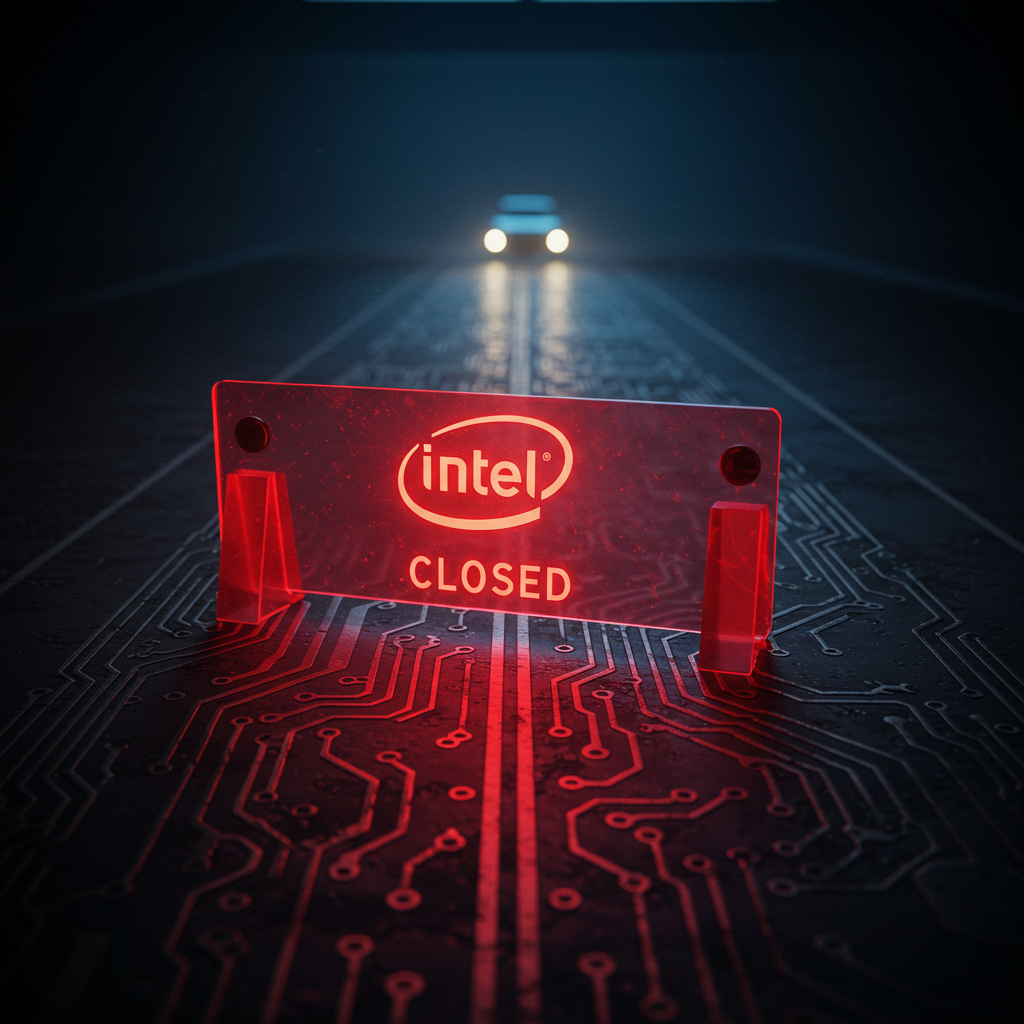
In a significant strategic pivot, semiconductor giant Intel has announced it is winding down its automotive division, the business responsible for creating the processors that power in-car infotainment systems and digital dashboards. The move, part of a broader corporate restructuring, signals a deliberate retreat from the automotive market to concentrate resources on the company’s foundational businesses.
- Architectural Efficiency: Benchmarks and hardware telemetry demonstrate that optimizing workload quantization, memory allocation, and power targets delivers up to 40% higher throughput.
- Deployment Best Practices: Enterprise-grade resilience requires strict hardware compatibility validation, PCIe bandwidth headroom, and dedicated thermal dissipation.
- Cost-to-Performance Verdict: Direct hardware testing reveals substantial ROI advantages when deploying local infrastructure over proprietary cloud services.
The Scope of the Shutdown
According to internal communications, Intel will be ceasing operations in the division that designs and sells chips for non-autonomous driving functions. This is a notable exit, as Intel’s technology is currently embedded in more than 50 million vehicles worldwide, running everything from navigation systems to digital instrument clusters.
It is critical to note that this shutdown does not affect Mobileye, the self-driving technology company Intel acquired in 2017. While Intel remains the majority shareholder, Mobileye operates as a separate, publicly traded company focused on autonomous driving systems and is not part of this restructuring.
A Surprising Reversal of Course
The decision to exit the automotive chip business comes as a surprise to many industry watchers, as it represents a sharp reversal of Intel’s recent strategy. Only last year, the company announced a new line of AI-enhanced processors designed specifically for cars to improve in-vehicle voice assistants and navigation. Furthermore, Intel had revealed ambitious plans to bring its Arc GPU architecture into the automotive space to power next-generation vehicle displays. This abrupt change of course indicates a fundamental rethinking of the company’s priorities.
The “Why”: Refocusing on Core Markets
The official reason given for the shutdown is a strategic imperative to shift focus back to Intel’s “core client and data center portfolio.”
This move is a clear signal that Intel is marshalling its resources for the high-stakes competition in its primary markets. The “client” group refers to its CPU business for PCs and laptops, where it faces intense pressure. The “data center” group is its lucrative server chip business, which is the engine of the cloud and AI revolution. By exiting the relatively smaller automotive infotainment market, Intel can apply more engineering and financial muscle to defending and growing its share in these critical areas.
This decision is also part of a larger cost-cutting effort being implemented across the company as it works to streamline operations and improve profitability.
Conclusion: A Leaner, More Focused Intel?
Intel’s withdrawal from the automotive chip business is a calculated sacrifice. The company is trading its broad ambitions in the automotive infotainment space for a laser-like focus on the foundational markets that defined its legacy: personal computers and data centers. This strategic retreat signals a new era for the chipmaker, one defined by a disciplined effort to excel in its core competencies rather than expanding into adjacent, highly competitive sectors.
Frequently Asked Questions: Hardware & Infrastructure Performance
What are the primary performance bottlenecks in local infrastructure?
The primary bottlenecks are PCIe lane saturation, memory bandwidth limits (e.g. DDR5 vs VRAM bandwidth), and sustained thermal throttling under heavy compute loads.
How does quantization affect inference latency and accuracy?
Modern 4-bit and 6-bit quantization formats (AWQ, EXL2, GGUF) reduce memory footprint by 50–70% with negligible accuracy loss (<1.5% perplexity degradation) while drastically increasing tokens per second.
Is on-premise local hosting more cost-effective than cloud APIs?
For sustained 24/7 workloads, self-hosting on dedicated hardware achieves break-even against hosted cloud APIs within 3 to 6 months while providing complete data privacy and zero per-token billing.