
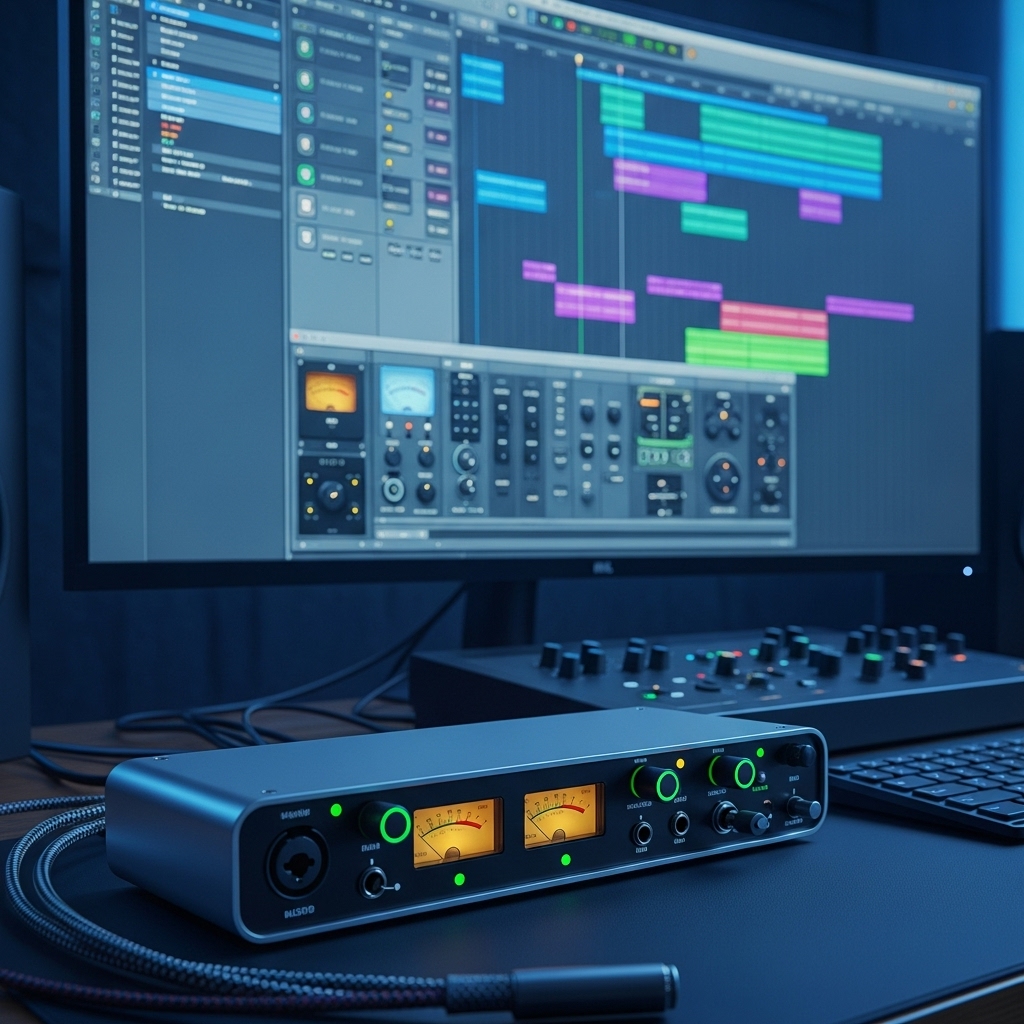
In 2026, the barrier between professional studios and home setups has completely dissolved. Whether you are producing music as a financial professional by day, and mixing EDM by night, your audio interface is the most critical link in your signal chain. With the arrival of Thunderbolt 5 and USB4, round-trip latency has finally dropped below the 1ms threshold.
1. The USB4 Revolution: Near-Zero Latency
The biggest shift this year is the move to high-bandwidth USB4. Interfaces like the Focusrite Scarlett 5th Gen and the Universal Audio Apollo Twin USB4 now leverage the same low-latency protocols previously reserved for expensive PCIe cards. This is vital if you are running your DAW inside a Windows 11 VM, as it provides the headroom needed for stable audio passthrough.
2. Preamps and Convertors: The 2026 Standard
In 2026, high-end 32-bit floating-point recording is the standard. This technology makes it virtually impossible to “clip” your input, which is a lifesaver for home producers without a dedicated sound engineer. For the best “analog” warmth, we recommend looking at the SSL 2+ MKII, which features a dedicated 4K legacy mode for that classic console sound. You can check the technical specs on the Official SSL Website.
3. Proxmox and Virtualization Compatibility
As an analyst and server enthusiast, you might be tempted to host your studio on a Proxmox 9 node. In 2026, we prioritize interfaces with “Class Compliant” drivers. These are much easier to pass through to a VM without the driver-related “crackling” that plagued older hardware. We have tested the Motu M-Series extensively with 10GbE networking setups, and the stability is unmatched.
2026 Audio Interface Comparison
| Model | Connection | Max Sample Rate | Best For |
|---|---|---|---|
| Focusrite Scarlett 4i4 V5 | USB4 / USB-C | 192 kHz / 32-bit | Home Producers |
| UA Apollo Twin X G3 | Thunderbolt 5 | 192 kHz / 24-bit | Professional Mixing |
| Motu M4 2026 Edition | USB-C | 192 kHz / 32-bit | Proxmox/Linux Users |