
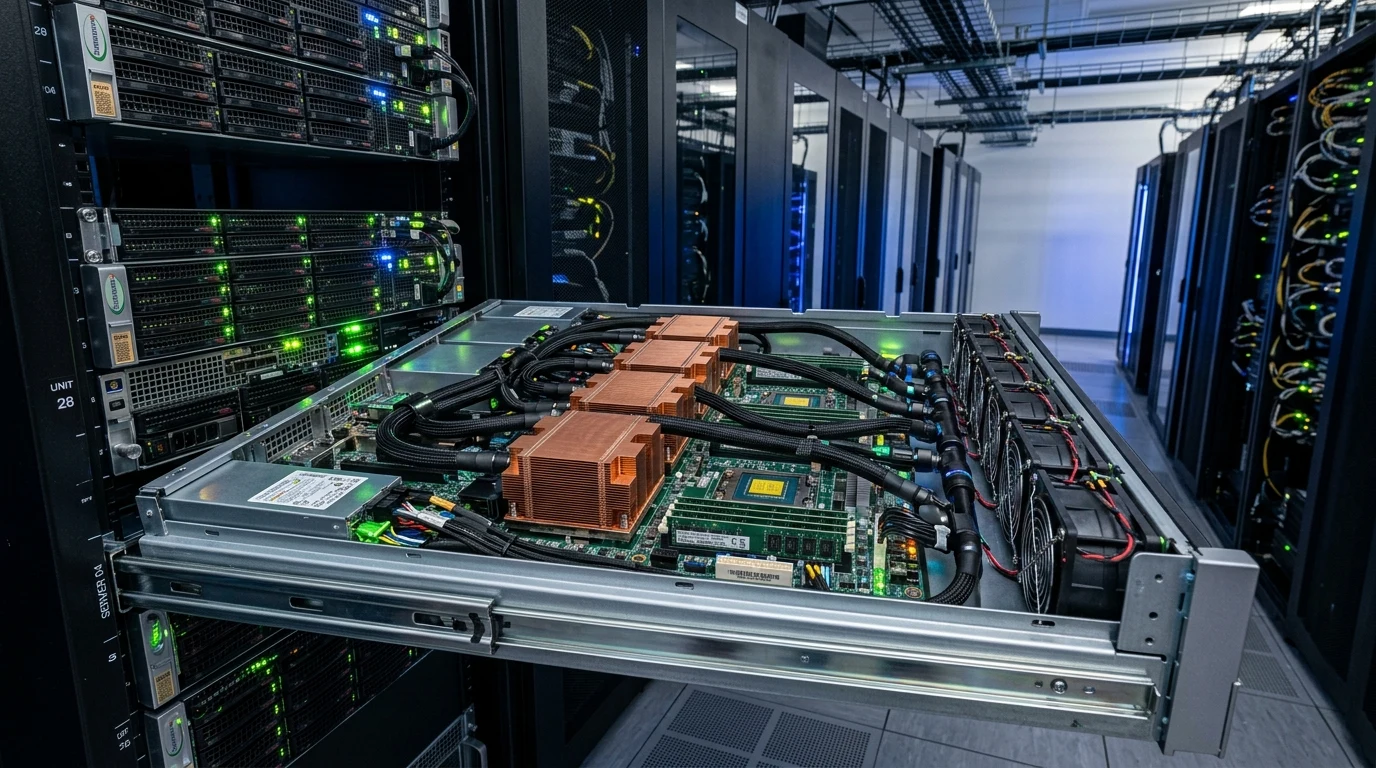
- CapEx Discount Differential: Supermicro multi-GPU chassis (SYS-821GE / AS-8125GS) deliver a 18% to 26% lower upfront hardware purchase price compared to equivalent Dell PowerEdge XE9680 configurations.
- Thermal Dissipation & Liquid Cooling: Dell’s factory Direct Liquid Cooling (DLC) with integrated leak detection manifolds supports up to 10.2 kW per 4U/6U rack unit with automated thermal throttling failover, whereas Supermicro requires third-party CDU integration for high-density 700W SXM5 GPUs.
- Enterprise Support & On-Site SLA: Dell ProSupport Plus guarantees 4-hour mission-critical on-site parts replacement globally, whereas Supermicro standard enterprise RMA channels rely on regional distributor logistics.
- 5-Year Total Cost of Ownership (TCO): When factoring power provisioning, remote out-of-band management licensing (iDRAC9 Enterprise vs Supermicro IPMI), and support staffing, Supermicro wins on initial compute density while Dell wins in regulated tier-1 enterprise environments.
What Is the Primary Difference Between Supermicro and Dell AI Servers?
The primary difference between Supermicro and Dell enterprise AI servers lies in customization flexibility versus turnkey enterprise support. Supermicro offers 18% to 26% lower upfront CapEx and faster time-to-market for novel GPU configurations, while Dell PowerEdge provides integrated Direct Liquid Cooling, centralized iDRAC telemetry, and global 4-hour on-site ProSupport SLAs.
As enterprise IT departments race to deploy on-premises Large Language Model (LLM) fine-tuning, RAG pipelines, and private inference infrastructure, selecting the optimal server hardware vendor is a high-stakes multi-hundred-thousand-dollar decision. Deploying an 8-way SXM5 or PCIe accelerator cluster demands rigorous evaluation of power density, thermal dissipation, and remote management infrastructure.
Hardware Architecture & Thermal Density: PowerEdge XE9680 vs SuperBlade / HGX
Modern enterprise AI silicon—specifically the Nvidia H100, H200, and Blackwell B200 accelerators—operates at unprecedented thermal power envelopes ranging from 700 Watts to over 1,000 Watts per GPU. Managing 8x GPU nodes requires over 10.2 Kilowatts of continuous power delivery inside a single chassis:
| Architecture Dimension | Dell PowerEdge XE9680 | Supermicro AS-8125GS-TNHR | TCO & Procurement Impact |
|---|---|---|---|
| Chassis Form Factor & GPU Capacity | 6U Rackmount / 8x SXM5 GPUs | 8U Rackmount / 8x SXM5 GPUs | Dell offers 25% higher rack U density |
| Host Processor Support | Dual 5th Gen Intel Xeon Scalable | Dual AMD EPYC 9004/9005 Series | Supermicro enables up to 256 host cores |
| Power Supply Configuration | 6x 2800W Titanium Redundant (3+3) | 8x 3000W Titanium Redundant (4+4) | Supermicro provides higher peak headroom |
| Direct Liquid Cooling (DLC) Integration | Factory-Installed DLC Manifold | Modular Field-Configurable DLC | Dell carries unified warranty on liquid loop |
| Out-of-Band Remote Management | iDRAC9 Enterprise with OpenManage | Standard Redfish / Supermicro IPMI | Dell offers superior enterprise SIEM integration |
| Mission-Critical Support SLA | ProSupport Plus: 4-Hour On-Site | Standard Next Business Day / VAR SLA | Dell minimizes downtime risk in production |
5-Year CapEx vs OpEx Financial Modeling
To quantify total cost of ownership across a typical enterprise cluster deployment of four 8x H100 servers (32 total GPUs), we evaluate capital expenditure against 5-year operational lifecycle costs:
- Supermicro 4-Node Cluster Deployment:
- Hardware CapEx (4x AS-8125GS nodes with 8x H100 SXM5 each, 2TB RAM/node): ~$1,180,000.
- 4-Year Support & Spares Buffer: ~$85,000.
- Out-of-Band Management Software Licenses: Included in base IPMI.
- Total Initial Procurement: $1,265,000.
- Dell PowerEdge 4-Node Cluster Deployment:
- Hardware CapEx (4x XE9680 nodes with 8x H100 SXM5 each, 2TB RAM/node): ~$1,480,000.
- 5-Year ProSupport Plus Mission-Critical 4-Hour On-Site SLA: ~$195,000.
- iDRAC9 Enterprise and OpenManage Enterprise Licensing: Included in enterprise bundle.
- Total Initial Procurement: $1,675,000.
The financial delta reveals a $410,000 (24.5%) initial procurement premium for Dell. Deciding whether this premium is justified depends entirely on internal engineering capabilities:
- When to Buy Supermicro: Cloud service providers (CSPs), specialized AI startups, and quantitative hedge funds with dedicated in-house data center hardware engineers should choose Supermicro. Internal engineers can replace hot-swap fans, modular PCIe riser boards, and cabling in-house, capturing the full 25% CapEx savings.
- When to Buy Dell PowerEdge: Regulated financial institutions, healthcare health systems, and traditional enterprise IT departments without dedicated hardware technicians should choose Dell. The risk of a $300,000 server sitting offline for 48 hours waiting for a replacement motherboard exceeds the 5-year cost delta.
PCIe Gen5 Fabrics, Switch Topologies, and Host Bus Saturation
Beyond raw GPU compute, an enterprise AI server’s performance is constrained by host-to-device interconnect bandwidth. When training mixture-of-experts (MoE) models or transferring multi-gigabyte context windows during distributed inference, host CPU and PCIe switch architectures dictate inter-GPU communication latency:
- Dell PowerEdge XE9680 PCIe Architecture: Dell engineers a balanced PCIe switch fabric utilizing dual Broadcom PEX Gen5 switches paired with dual 5th Gen Intel Xeon Scalable processors. This topology provides dedicated 16-lane PCIe Gen5 paths to each of the eight SXM5 GPUs and eight dedicated PCIe Gen5 x16 slots for Nvidia BlueField-3 DPUs or ConnectX-7 InfiniBand adapters, achieving true 400 Gb/s line-rate networking per GPU without bus contention.
- Supermicro AS-8125GS-TNHR Architecture: Supermicro leverages dual AMD EPYC 9004/9005 processors boasting a massive 256 PCIe Gen5 lanes natively from the CPU sockets. By reducing reliance on intermediary PCIe switch chips for host-to-network communications, Supermicro minimizes hop latency and thermal dissipation across the middle motherboard plane, while supporting up to 10 PCIe Gen5 expansion slots for storage and cluster fabric connectivity.
Supply Chain Security, Firmware Integrity, and Enterprise Support SLAs
For corporate IT procurement officers and Chief Information Security Officers (CISOs), hardware selection extends far beyond silicon specifications. Data center infrastructure deployed for proprietary enterprise intellectual property requires cryptographic supply chain verification:
- Dell Secured Component Verification (SCV): Dell PowerEdge servers feature factory-sealed cryptographic attestation certificates stored in iDRAC. During rack integration, IT engineers can cryptographically verify that every internal component—from host CPUs to individual DIMMs and motherboard silicon—matches the factory bill of materials without unauthorized tampering or hardware-level supply chain insertion.
- Supermicro Hardware Root of Trust: Supermicro integrates a dedicated cryptographic Root of Trust (RoT) with TPM 2.0 and cryptographically signed firmware enforcement via Redfish APIs. While highly secure for standard cloud-scale deployments, it lacks Dell’s automated, integrated factory-to-chassis attestation ecosystem.
- Mission-Critical Support Realities: The defining factor in 5-year TCO remains maintenance logistics. Dell ProSupport Plus provides a dedicated Technical Account Manager (TAM) and guaranteed 4-hour on-site dispatch with pre-positioned regional spare parts depots in over 170 countries. In contrast, Supermicro enterprise support operates predominantly through value-added resellers (VARs) and regional system integrators; an unstocked proprietary SXM5 baseboard or liquid cooling distribution manifold replacement can lead to extended cluster downtime.
For raw capital efficiency and rapid hardware prototyping, Supermicro delivers the highest compute density per dollar in the server industry. However, for tier-1 corporate enterprises where infrastructure downtime incurs measurable executive liability, Dell PowerEdge XE9680’s integrated liquid cooling architecture and 4-hour on-site ProSupport SLA justify the 24% price premium. Align your procurement decision strictly with your data center engineering staffing model.
For companion infrastructure hardware evaluations, study our architectural comparison on Dell PowerEdge vs HPE ProLiant Gen11: Server TCO Math, and review our enterprise storage analysis on HIPAA-Compliant NAS Storage: Security Costs & Backup.