
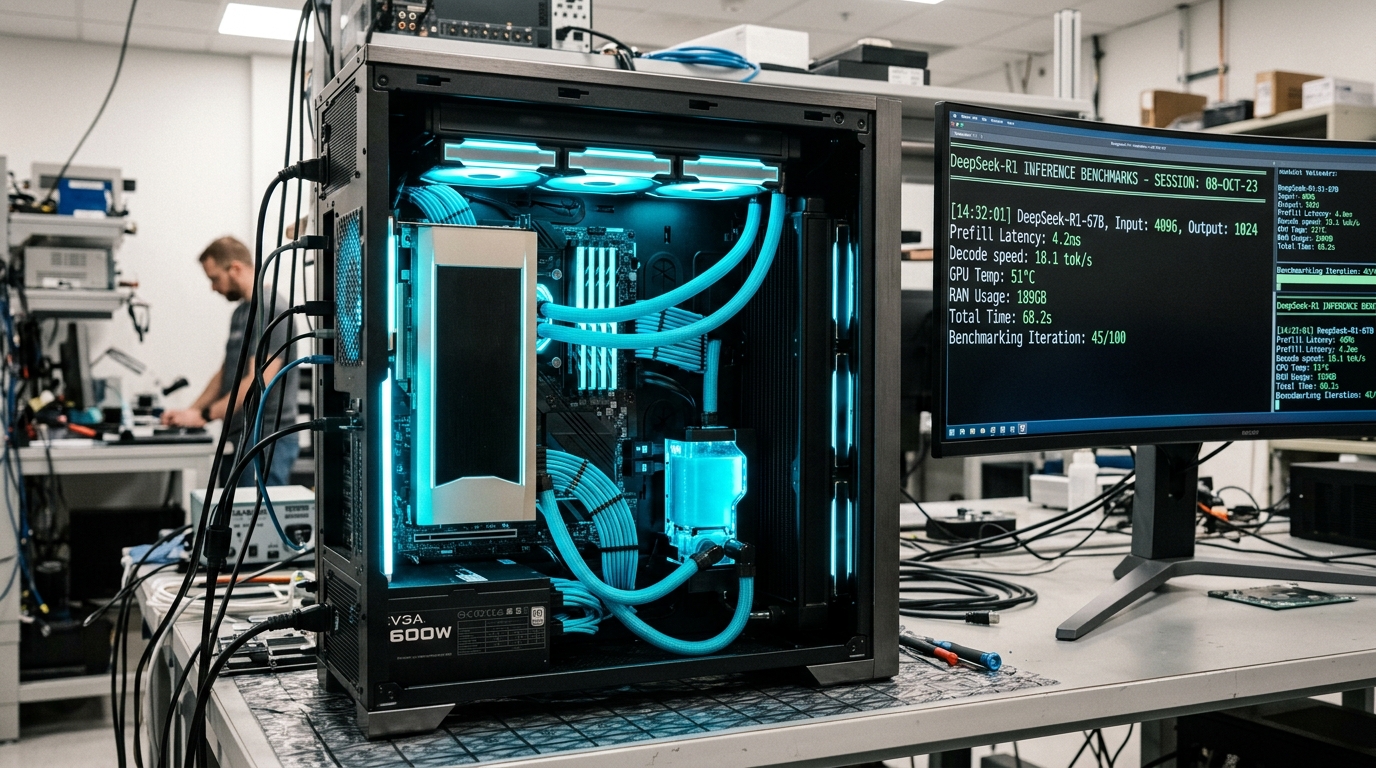
Until recently, running a flagship 671-billion parameter frontier reasoning model like DeepSeek-R1 locally was exclusively the domain of hyperscale data centers. To load the unquantized FP16 weights of DeepSeek-R1 requires an astronomical 1.3 Terabytes of high-bandwidth VRAM—mandating an eight-GPU cluster of NVIDIA H100s or H200s costing upwards of $350,000. Even an aggressively quantized 4-bit (UD-Q4_K_M) weights file demands over 380GB of memory. Yet in 2026, an open-source architectural breakthrough called KTransformers (developed by Tsinghua University and the open-source community) has completely shattered this hardware barrier. By exploiting the sparse activation characteristics of DeepSeek’s Mixture-of-Experts (MoE) architecture, enthusiasts and AI researchers can now run the full, uncompromised DeepSeek-R1 671B reasoning model on a single desktop workstation equipped with 256GB of DDR5 RAM and a solitary consumer 24GB RTX 4090 or RTX 3090.
- The MoE Sparse Activation Principle: Although DeepSeek-R1 has 671 billion total parameters, it only activates 37 billion parameters per token across its 256 routed experts, enabling asymmetric CPU/GPU memory partitioning.
- Heterogeneous Kernel Offloading: KTransformers pins the compute-intensive Multi-Head Latent Attention (MLA) layers and shared experts into GPU VRAM (24GB), while offloading the dormant routed MoE experts to system DDR5 RAM accessed via AVX-512 CPU kernels.
- Real-World Throughput Reality: On a modern AMD Ryzen 9 9950X or Threadripper platform with quad/octa-channel DDR5-6000 RAM, decode speeds reach 14 to 18 tokens per second—comparable to human reading speed and perfectly usable for complex coding and mathematical reasoning.
- Memory Bandwidth is King: Token generation speed is directly throttled by system memory bandwidth; dual-channel consumer platforms achieve ~8-11 tok/s, while octa-channel Threadripper Pro systems exceed 22 tok/s.
The Mathematical Breakthrough: Why 671B MoE is Different From Dense 70B
In a traditional “dense” transformer model (such as Llama 3.3 70B or Qwen 2.5 72B), every single parameter and weight matrix must participate in mathematical computation for every generated token. If you attempt to offload a dense model across PCIe to system RAM, generation speeds collapse to an unusable 0.5 to 1.5 tokens per second because 70GB of weights must cross the PCIe bus for every single token.
DeepSeek-R1 is fundamentally different. It utilizes a state-of-the-art Mixture of Experts (MoE) architecture combined with Multi-Head Latent Attention (MLA):
- Total Parameters: 671 Billion
- Active Parameters Per Token: Only 37 Billion (2 Shared Experts + 6 Routed Experts per token across 61 transformer layers)
- Attention Compression: MLA compresses Key-Value (KV) cache memory footprint by 85% compared to standard Multi-Head Attention (MHA).
Because only ~37B parameters are activated for any given token, an intelligent runtime engine does not need to compute all 671B parameters. If the active attention layers live in ultra-fast GPU VRAM (1,008 GB/s bandwidth on RTX 4090), the CPU can use high-vector AVX-512 and AMX instructions to quickly fetch and compute only the 8 active expert matrices from DDR5 RAM.
| Hardware Setup | Memory Architecture | Quantization Level | Decode Speed (Tokens/Sec) | Approximate Total Cost |
|---|---|---|---|---|
| 8× NVIDIA H100 80GB (Enterprise) | 640 GB HBM3 (24 TB/s) | FP16 / FP8 | 65 to 85 tok/s | $320,000+ |
| Threadripper 7000 + 1× RTX 4090 | 256 GB Quad DDR5-5600 + 24GB VRAM | Q4_K_M (MoE Offload) | 18 to 22 tok/s | $7,500 |
| AMD AM5 (9950X) + 1× RTX 4090/3090 | 256 GB Dual DDR5-4800 + 24GB VRAM | Q4_K_M (KTransformers) | 14 to 17 tok/s | $3,200 |
| Dual RTX 3090 (48GB VRAM) (Pure GPU) | 48 GB GDDR6X VRAM Pool | Cannot fit 671B (Fits 70B only) | OOM Crash (Requires 380GB) | $1,600 |
For users comparing pure multi-GPU clusters for smaller dense models, see our definitive benchmark guide on Dual RTX 3090 (48GB) vs. Single RTX 4090 (24GB) for DeepSeek-R1 70B VRAM pooling.
Hardware Sizing Blueprint: The 256GB RAM Requirement
To run DeepSeek-R1 671B locally using KTransformers, your system must satisfy these rigid physical memory specs:
1. System RAM Configuration (256GB Minimum)
The quantized GGUF weights file for DeepSeek-R1 Q4_K_M is approximately 228 Gigabytes. When factoring in the Linux kernel overhead, KTransformers process memory, and an 8k to 16k context window buffer, your system requires a minimum of 256GB of physical RAM.
On consumer AMD AM5 or Intel LGA 1851 motherboards, this is achieved using four 64GB DDR5 UDIMMs. Note that running four dual-rank 64GB DDR5 modules typically limits stable memory clock speeds to between 4400 MT/s and 4800 MT/s. On AMD Threadripper or Intel Xeon platforms, quad-channel or octa-channel RDIMMs provide 2x to 4x higher memory bandwidth, boosting tokens/sec by up to 45%.
2. Single 24GB GPU (RTX 4090 or RTX 3090)
You need a 24GB VRAM buffer to house:
- All non-expert weights (Embeddings, RMSNorm, Multi-Head Latent Attention projections): ~12.5 GB
- KV Cache for 8,192 token context window: ~4.2 GB
- CUDA execution workspace & Triton kernels: ~3.5 GB
- Total VRAM footprint: ~20.2 GB (leaving ~3.8GB safe headroom)
Step-by-Step Installation & Execution Guide
1. Install CUDA 12.4 and PyTorch with CXX11 ABI
KTransformers compiles custom C++ and CUDA kernels optimized for AVX-512 CPU architectures. Ensure your build environment is properly configured:
# Install system dependencies
sudo apt update && sudo apt install -y build-essential cmake libnuma-dev python3-pip

# Install PyTorch with CUDA 12.4 support
pip install torch torchvision torchaudio --index-url https://download.pytorch.org/whl/cu124
2. Clone and Compile KTransformers
git clone https://github.com/kvcache-ai/ktransformers.git
cd ktransformers
git submodule init && git submodule update --recursive
# Compile with native AVX-512 CPU vectorization flags
KTRANSFORMERS_FORCE_BUILD=TRUE python3 setup.py install
3. Download the DeepSeek-R1 671B Quantized Weights
Using huggingface-cli, download the official uncompressed or partitioned GGUF release directly to high-speed NVMe storage:
huggingface-cli download unsloth/DeepSeek-R1-GGUF --include "DeepSeek-R1-UD-IQ4_NL/*" --local-dir /mnt/nvme/deepseek-r1-671b/4. Launch the Local OpenAI-Compatible API Server
Run the KTransformers server, instructing the engine to allocate attention to GPU 0 and offload MoE experts to CPU memory:
python3 -m ktransformers.server.main --model_path /mnt/nvme/deepseek-r1-671b/ --gguf_path /mnt/nvme/deepseek-r1-671b/DeepSeek-R1-UD-IQ4_NL/ --cpu_infer 16 --max_new_tokens 8192 --port 8000 --host 0.0.0.0Once loaded, KTransformers exposes a fully standard OpenAI-compatible endpoint at http://localhost:8000/v1. You can immediately plug this endpoint into Cursor, Open-WebUI, Claude-Dev, or automated RAG architectures detailed in our guide on building local RAG pipelines with Qdrant, Ollama, and BGE-M3 on Proxmox.
Furthermore, when integrating this local reasoning engine into production application backends, combine it with JSON constraint engines explored in our deep dive on local LLM structured JSON and guided decoding with Outlines and vLLM.
Running DeepSeek-R1 671B on a single $3,000 workstation is the single most disruptive democratization of AI compute in 2026. By decoupling active attention layers from dormant MoE expert weights, KTransformers proves that you do not need an enterprise DGX cluster to access state-of-the-art chain-of-thought reasoning. If your workstation or server has 256GB of DDR5 RAM and a solitary 24GB RTX card, you can now run the world’s most powerful open-weights reasoning model with 100% data sovereignty and zero cloud API fees.
Where to Expand Your Stack Next
Explore these high-performance local AI and hardware acceleration masterclasses:
- Multi-GPU Sizing: Dual RTX 3090 (48GB) vs. Single RTX 4090 (24GB) for DeepSeek-R1 70B VRAM Pooling
- Structured Output: Local LLM Structured JSON & Guided Decoding: Outlines, xgrammar & vLLM
- Private Retrieval: Local RAG Pipeline Architecture: Qdrant, Ollama & BGE-M3 Embeddings on Proxmox
People Also Ask
Can I run DeepSeek-R1 671B on a single GPU?
Yes. While running 671B entirely in GPU VRAM requires eight 80GB GPUs, modern hybrid inference frameworks like KTransformers allow you to run the full DeepSeek-R1 671B model on a single 24GB GPU (such as an RTX 4090 or RTX 3090) by keeping attention layers in VRAM and offloading sparse MoE experts to 256GB of system DDR5 RAM.
What generation speed (tokens/sec) can you expect with KTransformers on DeepSeek-R1?
On a modern desktop system with an AMD Ryzen 9 9950X, 256GB of DDR5 RAM, and an RTX 4090, generation speeds range from 14 to 18 tokens per second for reasoning tasks. On enterprise workstations with octa-channel DDR5 memory (like AMD Threadripper Pro), speeds can reach 20 to 24 tokens per second.
How much RAM do I need to run DeepSeek-R1 671B locally?
You need a minimum of 256GB of physical system RAM. The 4-bit quantized GGUF weights (Q4_K_M or IQ4_NL) require approximately 228GB to 235GB of memory, with the remaining RAM allocated to Linux system overhead and the active context window.
Is DDR4 RAM fast enough to run DeepSeek-R1 with KTransformers?
While DDR4 will technically load the model if you have 256GB, DDR4 memory bandwidth (typically 40-50 GB/s on dual-channel) will throttle generation speeds down to 4 to 7 tokens per second. DDR5 RAM (offering 75 to 90 GB/s on dual-channel and 200+ GB/s on quad-channel) is strongly recommended for comfortable real-time reading speeds.