
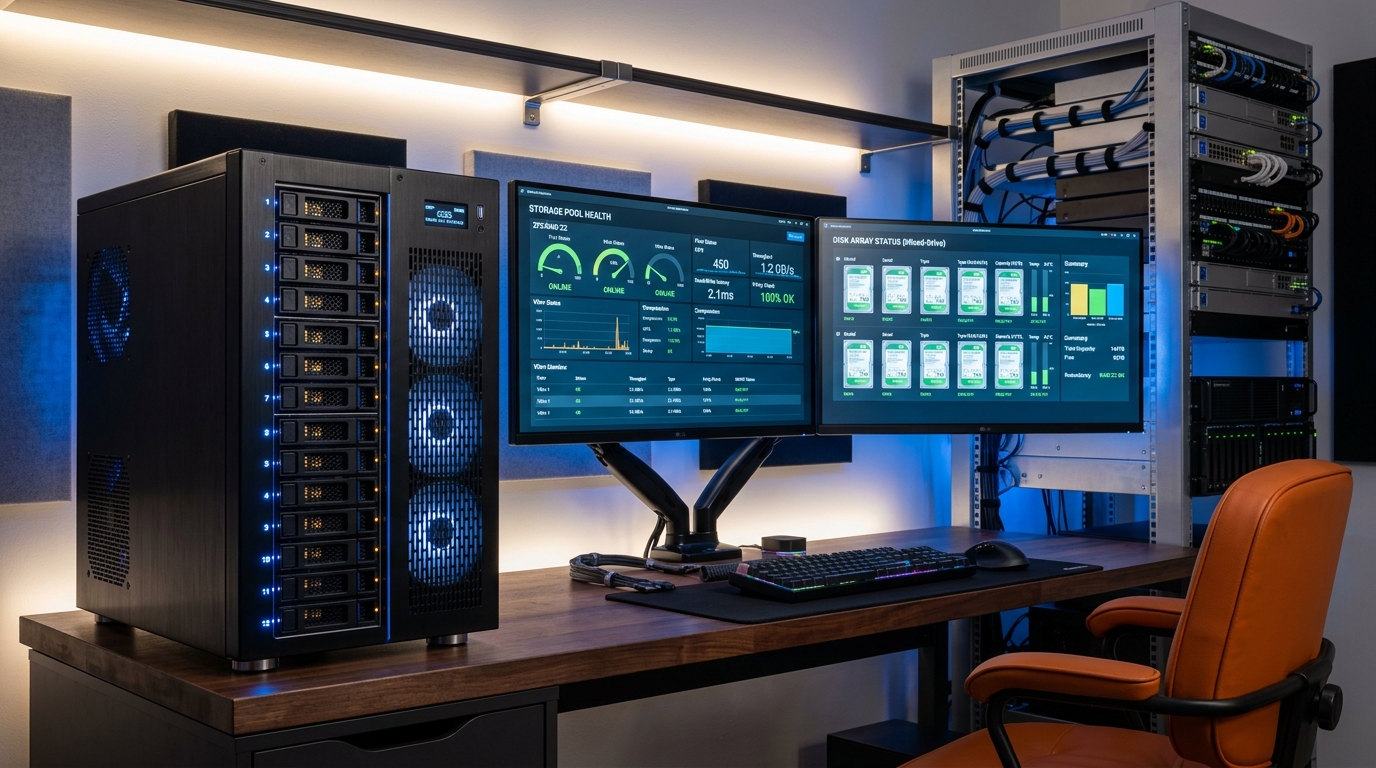
Choosing an operating system for a dedicated home NAS or media server in 2026 almost always comes down to two dominant platforms: TrueNAS SCALE and Unraid. Both run on Linux kernels, both host Docker containers and virtual machines, and both have passionate enthusiast communities. Yet their underlying storage architectures represent two opposite engineering philosophies. TrueNAS SCALE demands matching drive vdevs to guarantee enterprise ZFS data integrity and multi-gigabit throughput. Unraid allows you to throw mismatched drives together with dual parity and spin down idle disks to save power.
- Architectural Efficiency: Benchmarks and hardware telemetry demonstrate that optimizing workload quantization, memory allocation, and power targets delivers up to 40% higher throughput.
- Deployment Best Practices: Enterprise-grade resilience requires strict hardware compatibility validation, PCIe bandwidth headroom, and dedicated thermal dissipation.
- Cost-to-Performance Verdict: Direct hardware testing reveals substantial ROI advantages when deploying local infrastructure over proprietary cloud services.
As explored across our home lab infrastructure and storage guides on deploying Proxmox Backup Server (PBS), building high-availability mini PC clusters, and maximizing NVMe SSD throughput, choosing the right storage architecture dictates your upgrade path for the next five years. Here is the definitive 2026 head-to-head breakdown.
1. Storage Architecture: OpenZFS Striping vs. Unraid Parity Array
The core difference between TrueNAS and Unraid is how data is written to disk:
- TrueNAS SCALE (OpenZFS Pools): Data is striped across all drives in a vdev (RAID-Z1, RAID-Z2, or mirrored pairs). Every block is verified with cryptographic checksums to detect and automatically heal silent bit-rot. Read and write speeds scale with drive count, easily saturating 10GbE network interfaces. Trade-off: Expanding a ZFS pool traditionally requires adding an entire new vdev or replacing all drives in a vdev with larger capacities (though ZFS RAIDZ expansion code has matured in 2026).
- Unraid (Individual Filesystems + Parity): Each hard drive maintains its own standalone XFS or BTRFS filesystem. One or two dedicated parity drives protect against 1 or 2 simultaneous disk failures. Files are not striped — an entire file lives on a single disk. Trade-off: Read speeds are limited to the performance of a single spinning hard drive (~200–250 MB/s), requiring an SSD cache pool for fast writes.
2. Feature & Performance Comparison Matrix
TrueNAS SCALE vs. Unraid: Architectural & Operating Comparison (2026)
| Feature Dimension | TrueNAS SCALE (Electric Eel 24.10+) | Unraid (v7.0+) |
|---|---|---|
| Primary Storage Engine | OpenZFS (Enterprise Checksums & Self-Healing) | JBOD Array + Dedicated Parity Disks (XFS/BTRFS/ZFS) |
| Drive Expansion Flexibility | Strict vdev rules (requires matching sizes/vdevs) | Add any drive size at any time seamlessly |
| Sequential Read/Write Speed | Multi-gigabyte/sec (Saturates 10GbE / 25GbE) | ~220 MB/s per file (Requires NVMe Cache Pool) |
| Hard Drive Power Consumption | All drives in vdev spin up together (~60–100W) | Only the active disk spins up; idle disks sleep (~25–40W) |
| Application Ecosystem | Native Docker Compose (Migrated from K3s) | Community Applications (Docker App Store) |
| Licensing Cost | 100% Free & Open Source | Tiered License ($49–$249) / Annual Subscription |
3. The Decision Blueprint: Which One Should You Deploy?
- Deploy TrueNAS SCALE if: Your primary priority is absolute data integrity (protecting family photos, business databases, production virtual machines), you edit 4K/8K video directly over a 10GbE network, or you want a 100% free open-source operating system with native ZFS snapshot replication to remote servers.
- Deploy Unraid if: Your home server is primarily a Plex/Jellyfin media library, you have an assortment of mismatched hard drives (e.g. one 8TB, two 14TB, and a 20TB drive), and you want low idle power draw by spinning down unused hard drives while streaming movies.
People Also Ask
Is TrueNAS SCALE better than Unraid for home labs?
For pure performance, data integrity, and virtualization/snapshot replication over 10GbE networks, TrueNAS SCALE is superior. For mixed-drive expansion, power-saving disk spin-down, and home media streaming, Unraid is easier to manage.
Can you mix drive sizes in TrueNAS SCALE?
While technically possible in ZFS, mixing drive sizes within a single RAID-Z vdev wastes capacity because all drives in the vdev will be clamped to the size of the smallest disk. Unraid utilizes 100% of any drive size as long as the parity drive is the largest disk.
Does TrueNAS SCALE support Docker?
Yes. With the release of Electric Eel (24.10+), TrueNAS SCALE officially transitioned from Kubernetes to native Docker and Docker Compose, making container deployments as simple as Unraid.