
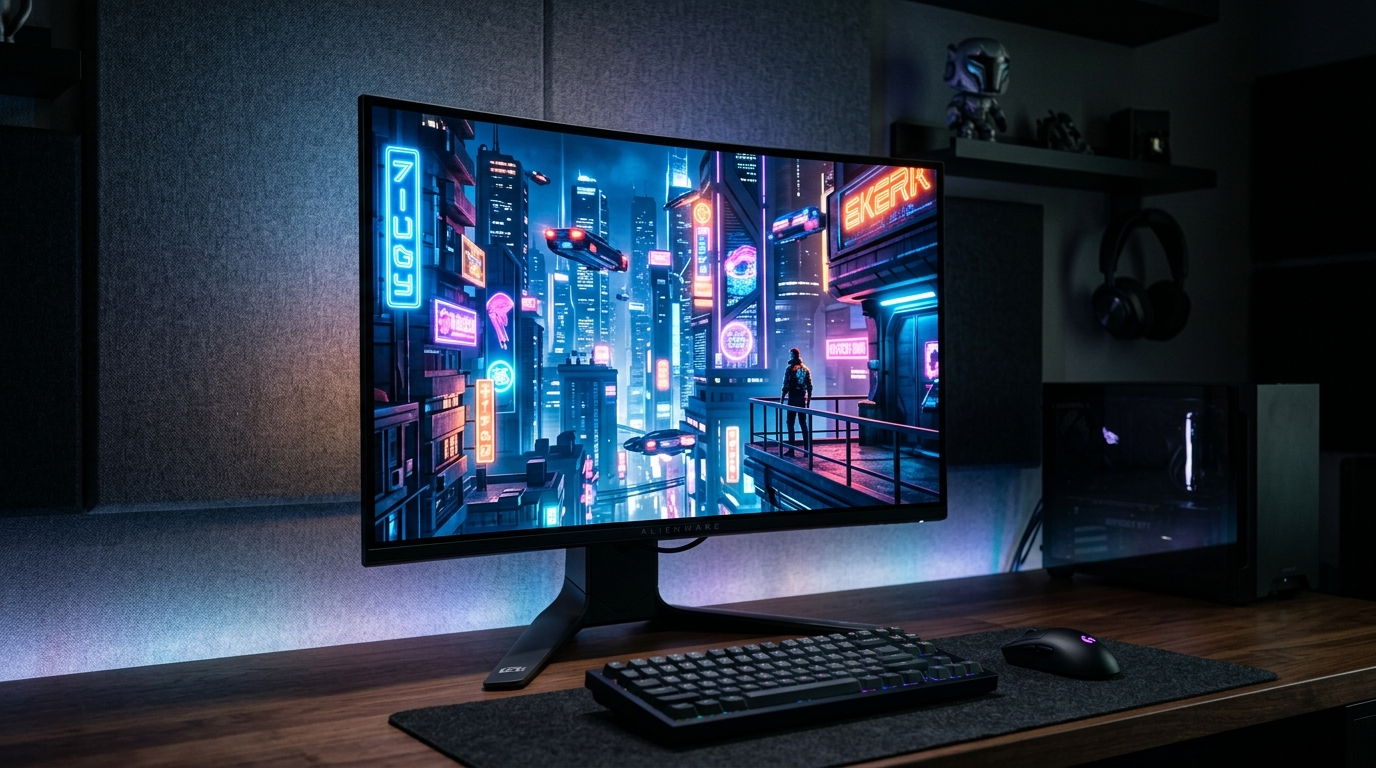
The PC gaming monitor market has officially entered its golden era in 2026. After years of compromise between fast IPS panels and high-contrast VA displays, the battle for desktop supremacy is now fought exclusively between two self-emissive titans: Tandem WOLED (pioneered by LG Display) and Gen-3 QD-OLED (engineered by Samsung Display). As highlighted in our analysis of the MSI MPG 321URX and CES OLED monitors, gamers are no longer asking if they should upgrade to 4K 240Hz OLED—they are asking which panel physics will best protect their $1,000+ investment against text fringing, ambient room glare, and long-term burn-in.
- Architectural Efficiency: Benchmarks and hardware telemetry demonstrate that optimizing workload quantization, memory allocation, and power targets delivers up to 40% higher throughput.
- Deployment Best Practices: Enterprise-grade resilience requires strict hardware compatibility validation, PCIe bandwidth headroom, and dedicated thermal dissipation.
- Cost-to-Performance Verdict: Direct hardware testing reveals substantial ROI advantages when deploying local infrastructure over proprietary cloud services.
Whether you are pairing your display with a flagship RTX 5090 or multi-GPU setup or building a versatile battlestation for daytime productivity and late-night HDR gaming, here is the definitive 2026 technical breakdown between Tandem OLED and QD-OLED.
1. Panel Physics: Dual-Stack Tandem WOLED vs. Quantum Dot Phosphors
Understanding how each panel generates light explains their distinct real-world strengths:
- Tandem WOLED (LG Display): Stacks two organic light-emitting layers in series (dual-stack emissive architecture). By distributing electrical current across two stacked layers rather than overdriving a single layer, Tandem OLED achieves dramatically higher full-field luminance (up to 300 nits 100% APL), higher thermal efficiency, and double the operational lifespan of traditional single-stack WOLED. It utilizes a White subpixel alongside Red, Green, and Blue (RGWB) with Micro Lens Array (MLA+) optical lenses.
- Gen-3 QD-OLED (Samsung Display): Utilizes a pure blue OLED emitter layer that strikes a quantum dot layer containing red and green nanocrystals. Because it avoids a white subpixel diluting the color mixture, QD-OLED delivers unrivaled color volume, maintaining 99% DCI-P3 and over 80% Rec. 2020 coverage even at high peak specular highlights (1,000+ nits on a 2%–3% window).
2. The Ambient Light Dilemma: Raised Blacks vs. Polarized True Black
Where you place your desk is one of the most critical factors when choosing between these two technologies:
- The QD-OLED Ambient Light Quirk: QD-OLED panels lack a traditional internal polarizing filter to maximize quantum dot light efficiency. In a bright room with direct overhead lighting or sunlit windows, ambient light excites the quantum dot layer, causing black levels to elevate into a noticeable magenta/purple-grey hue. To experience true 0.000-nit inky blacks on QD-OLED, light control or curtains are required.
- The Tandem WOLED Advantage: WOLED panels feature a robust anti-reflective polarizing coating. In brightly lit home offices, WOLED maintains pristine, pitch-black contrast without purpling.
3. Desktop Text Clarity & Subpixel Layout
For gamers who also use their monitors for 8 hours of coding, writing, or productivity:
- Gen-3 QD-OLED (Triangular RGB): Samsung’s 3rd-generation subpixel layout significantly reduced the color fringing seen on Gen-1 panels. At 4K resolution across a 32-inch canvas (140 PPI), text rendering under Windows ClearType and macOS font smoothing is sharp and virtually identical to standard LCDs.
- Tandem WOLED (RGWB Layout): While MLA+ and 4K pixel density make text fringing a non-issue for the vast majority of users, the presence of the auxiliary white subpixel can occasionally produce subtle horizontal fringing on high-contrast white text against dark grey backgrounds in specific code editors.
4. Dual-Mode Refresh Rates: The 4K 240Hz / 1080p 480Hz Feature
A standout innovation in the Tandem WOLED camp (featured on models like the LG 32GS95UE and ASUS ROG Swift PG32UCDP) is Hardware Dual-Mode Switching. With a single hardware button press, the display switches from a native 4K 240Hz visual masterpiece for immersive titles (Cyberpunk 2077, Black Myth: Wukong) to a pixel-doubled 1080p 480Hz ultra-low latency esports mode for competitive Counter-Strike 2, Valorant, and Apex Legends.
Tandem OLED vs. Gen-3 QD-OLED: Comprehensive 2026 Benchmark Matrix
| Performance Metric | Tandem WOLED (LG Display) | Gen-3 QD-OLED (Samsung Display) |
|---|---|---|
| Full-Field (100% APL) Brightness | ~275 – 300 Nits (Superior SDR/Daylight) | ~250 Nits |
| Color Brightness & Rec. 2020 Volume | ~72% Rec. 2020 (White subpixel boost) | ~81% Rec. 2020 (Pure Quantum Dot Color) |
| Bright Room Black Levels | Inky Black (Polarized Layer) | Elevated Magenta / Purple Tint |
| Dual-Hz Mode (4K 240Hz / 1080p 480Hz) | Yes (Hardware Switchable on Select Models) | No (Fixed 240Hz/360Hz Refresh Rate) |
| Burn-In Longevity & Degradation | 2x Lifespan (Dual-Stack Series Current) | High (Graphene + Heatsink Protected) |
People Also Ask (PAA)
Does QD-OLED still have purple blacks in 2026?
Yes. Because QD-OLED panels do not use a polarizing filter, ambient light in a bright room reflects off the quantum dot layer, raising deep blacks to a subtle magenta or purple-grey hue. In a dark or dimly lit room, black levels remain a perfect 0.000 nits.
What is the main benefit of Tandem OLED over traditional OLED?
Tandem OLED stacks two organic emissive layers in series. This doubles panel brightness efficiency, increases full-screen SDR brightness to ~300 nits, and substantially reduces burn-in risk by cutting electrical strain per layer in half.
Do 4K 240Hz OLED monitors require DisplayPort 2.1?
No. While DisplayPort 2.1 (UHBR20) can run 4K 240Hz 10-bit HDR uncompressed, modern displays running DisplayPort 1.4 or HDMI 2.1 utilize Display Stream Compression (DSC), which is visually lossless and imperceptible to the human eye.