
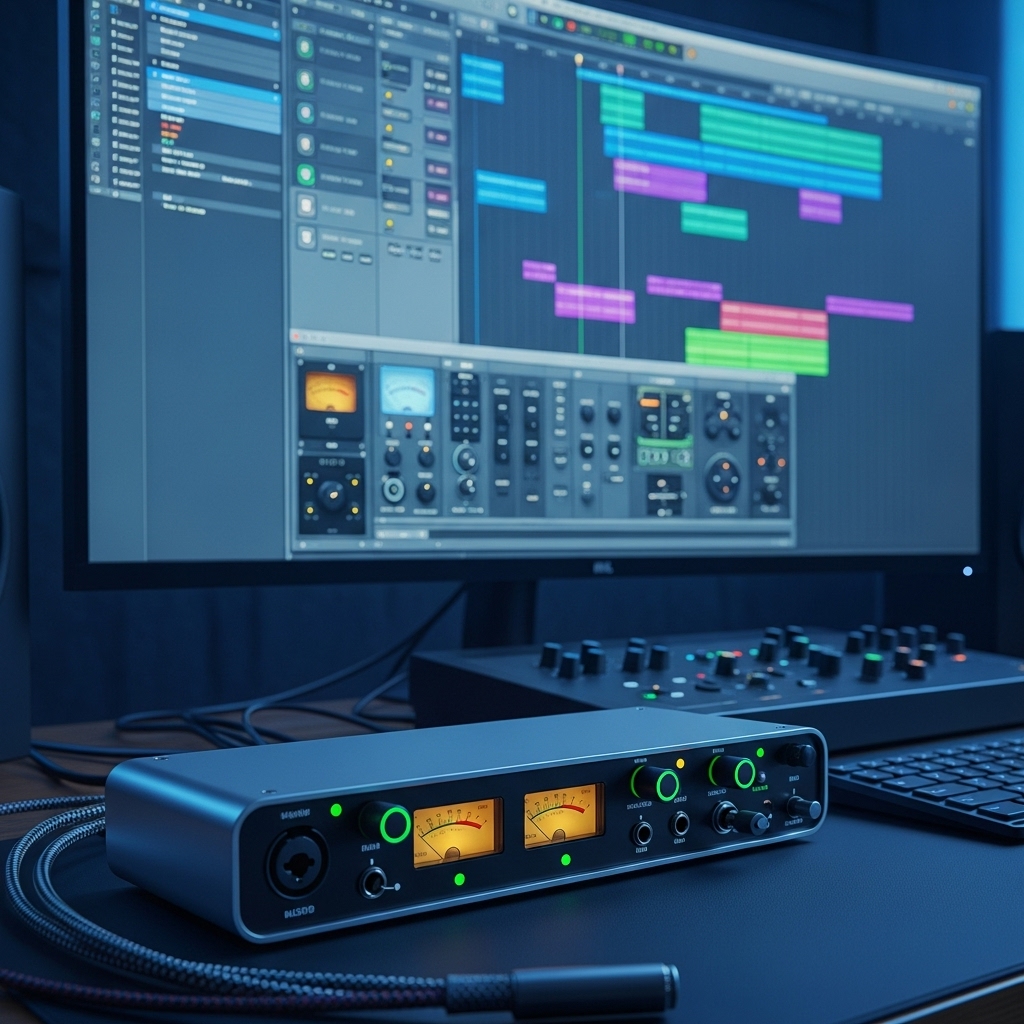
Whether you are building a dedicated music recording studio, streaming high-production broadcast content, or engineering multi-track podcast networks, the USB audio interface is the physical bridge between the acoustic world and digital signal processing. Inside this compact metal enclosure sits an intricate chain of analog preamplifiers, analog-to-digital converters (ADC), digital-to-analog converters (DAC), ultra-low-noise clocking oscillators, and USB bus transceiver controllers. In 2026, the audio interface market reached extraordinary technical heights: entry-level $150 units now boast dynamic ranges that surpassed million-dollar mixing consoles from two decades ago. However, marketing specifications frequently camouflage critical hardware trade-offs in roundtrip latency (RTL), operational driver stability under sustained multi-thread DAW load, and true microphone preamplifier Equivalent Input Noise (EIN).
For budget creators under $200, the Focusrite Scarlett 2i2 4th Gen leads the pack with pristine 120dB dynamic range converters and 69dB of clean preamp gain that powers low-output microphones (like the Shure SM7B) without cloudlifter inline preamps. In the prosumer bracket ($250–$400), the MOTU M4 delivers class-leading ESS Sabre32 Ultra DACs and sub-4.2ms roundtrip latency. For uncompromising professional broadcast and mission-critical tracking, the RME Babyface Pro FS remains the undisputed gold standard due to rock-solid custom FPGA USB drivers and zero dropouts at 32-sample buffer sizes.
The Anatomy of Modern USB Audio Hardware Architecture
When evaluating audio interfaces, spec sheets can be misleading. Manufacturers highlight “192kHz / 24-bit capability”—a feature that is virtually standard across every modern DAC chip. The true engineering benchmarks that distinguish elite hardware from mediocre plastic enclosures center on three parameters:
- Equivalent Input Noise (EIN): Measured in dBu (typically -128 dBu to -131 dBu at 150 ohms). The closer this number is to theoretical thermal noise limits (-133 dBu at room temperature), the cleaner your recordings will sound when boosting quiet voiceover passages.
- Converter Dynamic Range (ADC/DAC): Measured in A-weighted decibels (dBFS). Higher dynamic range allows tracking signals with wide transient spikes without clipping or digital distortion.
- ASIO / CoreAudio Roundtrip Latency (RTL): The exact roundtrip delay (in milliseconds) from when audio enters an XLR jack, travels through USB buffers into your DAW, processes through plugins, and returns to your monitor headphones. Lower RTL allows musicians to track vocals with live software reverb without hearing an echo.
2026 Hardware Shootout: Technical Benchmark Comparison
| Audio Interface | Preamp Gain | Noise (EIN) | DAC Dynamic Range | RTL (96kHz / 64 Samples) | Driver Architecture |
|---|---|---|---|---|---|
| Focusrite Scarlett 2i2 4th Gen | 69 dB | -127 dBu | 120 dB (RedNet Chips) | 5.1 ms | Proprietary ASIO / USB Audio 2.0 |
| MOTU M4 | 60 dB | -129 dBu | 120 dB (ESS Sabre32) | 4.1 ms | Ultra-low jitter USB drivers |
| Universal Audio Volt 276 | 55 dB | -128 dBu | 110 dB | 5.8 ms | Custom CoreAudio / ASIO |
| Solid State Logic SSL2+ MkII | 64 dB | -130.5 dBu | 120 dB (32-bit support) | 4.8 ms | Low-latency SSL ASIO Core |
| RME Babyface Pro FS | 76 dB (Digital) | -130 dBu | 118 dB | 3.1 ms (Class Leader) | Hardware FPGA Custom USB Controller |
In-Depth Hardware Breakdown: Which Unit Suits Your Production Needs?
1. Focusrite Scarlett 2i2 (4th Gen): The Democratized Flagship
In previous generations, the Scarlett series was plagued by mediocre 56dB preamps that struggled to drive dynamic microphones without introducing audible noise, forcing users to buy $100 Cloudlifter preamps. In the 4th Generation, Focusrite completely redesigned the analog front-end: preamp gain jumped to an astonishing 69 dB, and the D/A converters were upgraded to the exact same CIRRUS Logic flagship components utilized in Focusrite’s $3,000+ RedNet enterprise studio systems. Additionally, the inclusion of automated gain staging (Auto Gain) and Clip Safe protection (which dynamically monitors incoming levels and trims gain before digital distortion occurs) makes it practically impossible to ruin a recording.
2. MOTU M4: The Converter and Measurement Champion
The MOTU M4 remains a favorite among audio engineers and acoustic researchers for a singular reason: its front panel features a full-color high-resolution LCD display providing real-time calibrated level meters with numerical peak hold. Under the hood, MOTU incorporates high-end ESS Sabre32 Ultra DACs that output an impeccably flat frequency response with exceptionally low total harmonic distortion (THD+N at 0.0004%). Furthermore, the M4 includes two dedicated virtual loopback channels, enabling seamless routing of Discord chat, OBS audio, and DAW tracks without third-party software virtual cables.
3. Universal Audio Volt 276: Analog Coloration in a Box
Unlike Focusrite and MOTU, which prioritize analytical, transparent conversion, Universal Audio engineered the Volt 276 for analog warmth. It integrates a discrete analog FET compressor circuit modeled directly on UA’s legendary 1176 hardware limiter. With three push-button compressor presets (Vocals, Guitar, Fast transients) and a tube-emulated “Vintage Preamp” saturation button, podcasters and musicians can track punchy, broadcast-ready vocals with hardware peak limiting directly before the signal hits the A/D converters.
4. RME Babyface Pro FS: The Bulletproof Broadcast Standard
Priced around $999, the RME Babyface Pro FS occupies an entirely different tier of engineering. While almost every other manufacturer buys off-the-shelf third-party USB interface chips (from XMOS or Microchip) and wraps them in generic ASIO driver wrappers, RME engineers their entire USB transceiver protocol directly into an onboard Xilinx FPGA (Field Programmable Gate Array). RME writes every line of driver assembly code in-house. The result is unparalleled driver stability: the Babyface Pro FS can run at 32 samples buffer size with near-zero latency for weeks on end without dropping a single sample. Coupled with SteadyClock FS jitter rejection, it represents a lifetime studio investment.
Headphone Amplification: Driving High-Impedance Studio Cans
A frequently neglected specification on USB-powered audio interfaces is headphone output power and output impedance. High-impedance studio reference headphones, such as the 300-ohm Sennheiser HD600 or the 250-ohm Beyerdynamic DT990 Pro, require substantial voltage swing to deliver accurate bass transient response and full dynamic range. Many entry-level bus-powered interfaces deliver less than 30 milliwatts into 300 ohms, resulting in quiet playback and muddy, distorted low frequencies when tracking.
The MOTU M4 and Focusrite Scarlett 4th Gen address this by integrating dedicated high-current headphone output stages capable of delivering over 150mW into 300 ohms with an ultra-low output impedance below 1 ohm. A low output impedance ensures an optimal electrical damping factor, preventing frequency response deviations when using low-impedance multi-driver balanced armature in-ear monitors (IEMs).
Studio Optimization Blueprint: Eliminating USB Ground Loops and DPC Latency
Jay Tech’s Studio Wiring & Acoustic Checklist
- Analyze DPC Latency Spikes with LatencyMon: In Windows 11, mysterious audio dropouts, pops, and clicks during DAW recording are almost never caused by the audio interface itself; they stem from Delayed Procedure Calls (DPC) generated by misbehaving Wi-Fi drivers, power throttling (
ACPI.sys), or GPU drivers (nvlddmkm.sys). Run LatencyMon to identify and disable conflicting kernel drivers. - Avoid Front-Panel Motherboard USB Ports: Front-panel case headers run unshielded ribbon cables past high-frequency GPU VRMs and power supply lines, picking up electromagnetic interference (audible as high-pitched buzzing in monitors when moving the mouse). Always plug your audio interface directly into rear motherboard I/O ports connected to the primary chipset controller.
- Deploy Balanced TRS-to-XLR Cables to Studio Monitors: Unbalanced 1/4″ TS cables act as antennas for RF noise. Balanced 3-pin cables utilize phase-cancellation (common-mode rejection) to nullify external hum across long cable runs.
- Calibrate Windows Power Management: In Windows Device Manager, expand Universal Serial Bus controllers, right-click your root hubs, select Properties -> Power Management, and uncheck “Allow the computer to turn off this device to save power” to eliminate ASIO audio dropouts during system idle transitions.
Clock Jitter and FPGA Synchronization: Why Microseconds Matter
Behind the analog-to-digital conversion stage lies the master digital clock oscillator. In high-resolution digital audio, time-domain precision is paramount. Clock jitter—minute timing fluctuations in the sampling crystal—causes subtle phase distortion, stereo image blurring, and intermodulation distortion in the audible 2kHz to 10kHz frequency band. Entry-level consumer interfaces rely on generic quartz crystals with phase jitter figures exceeding 500 picoseconds. While adequate for casual podcasts, this clock drift compromises transient clarity when recording multi-mic acoustic drum kits or pristine orchestral strings.
High-end studio manufacturers invest heavily in proprietary clocking solutions. RME’s SteadyClock FS technology utilizes digital frequency synthesizers paired with analog quartz filters, suppressing jitter to the femtosecond range (under 1 picosecond). This clocking circuitry operates seamlessly across external ADAT and S/PDIF digital optical expansions, ensuring that when you connect an auxiliary 8-channel microphone preamp (such as an Audient ASP880 or Focusrite Clarett OctoPre) via TOSLink, all channels remain locked in absolute phase coherence without digital clicks or pops.
Additionally, modern USB interfaces incorporate dedicated USB-C power delivery negotiation. Operating from a true 15W (5V / 3A) USB-C power rail allows the internal DC-DC converters to supply full, uncompromised +48V phantom power rails simultaneously across all XLR inputs without dragging down preamp headroom or causing transient clipping on large diaphragm condenser microphones.
When selecting between USB-C bus power and external DC power supplies, note that high-performance class-A preamplifiers achieve superior transient response and lower intermodulation distortion when supplied with dedicated linear power adapters. External power eliminates USB host controller current throttling during multi-channel tracking sessions with 48V phantom power engaged across all inputs.