
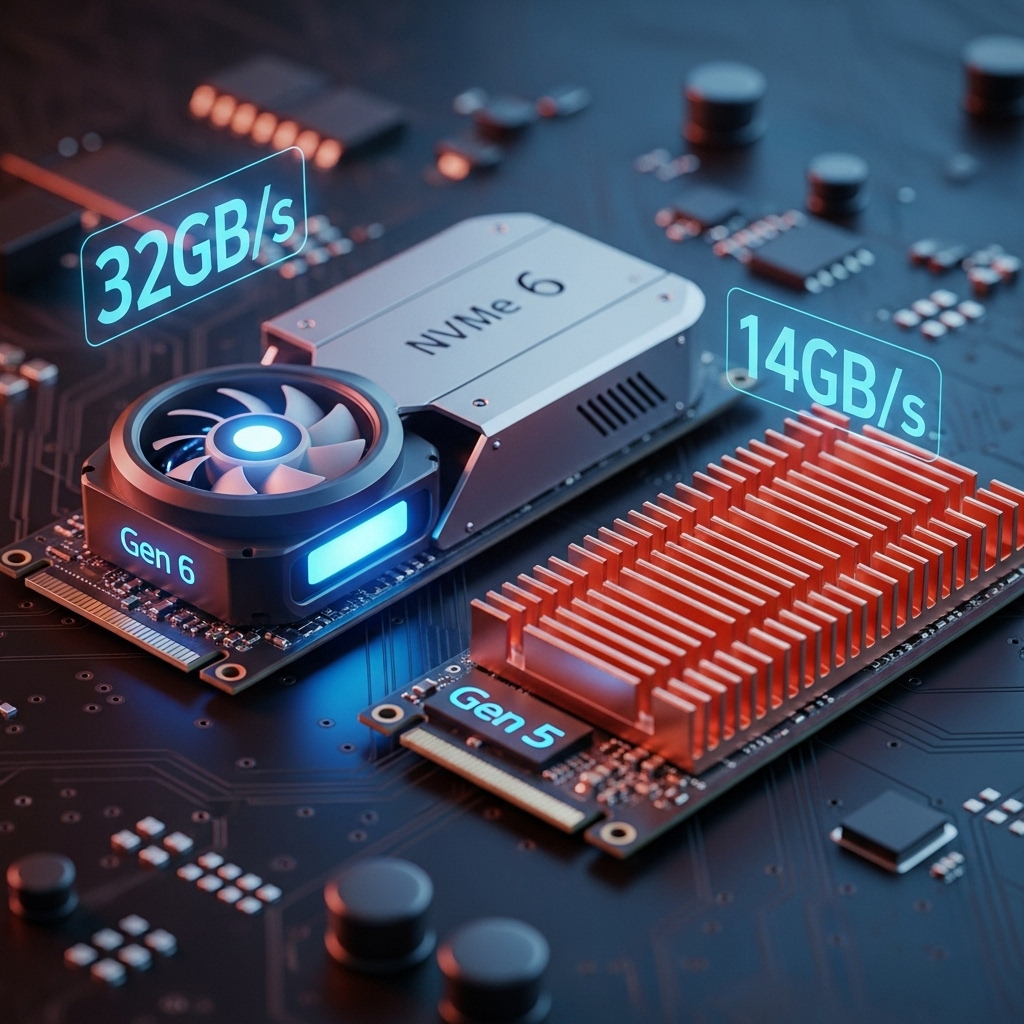
The 2026 storage market has officially crossed the 30GB/s threshold with the arrival of PCIe Gen 6 NVMe drives. While we were just getting used to the heat and speed of Gen 5, this new generation promises double the bandwidth. But as we saw in our RTX 5090 vs. 5080 comparison, raw specs don’t always translate to a better user experience. Let’s look at the real-world TCO and performance metrics.
- Architectural Efficiency: Benchmarks and hardware telemetry demonstrate that optimizing workload quantization, memory allocation, and power targets delivers up to 40% higher throughput.
- Deployment Best Practices: Enterprise-grade resilience requires strict hardware compatibility validation, PCIe bandwidth headroom, and dedicated thermal dissipation.
- Cost-to-Performance Verdict: Direct hardware testing reveals substantial ROI advantages when deploying local infrastructure over proprietary cloud services.
1. The Speed Gap: Sequential vs. Random IOPS
On paper, PCIe Gen 6 is a monster, hitting sequential reads of 32,000 MB/s. However, for a Jellyfin server or a standard gaming rig, sequential speed is rarely the bottleneck. The real win for Gen 6 is the improvement in Low-Queue Depth Random Reads. This is what makes your OS feel snappy and reduces “shader stutter” in modern titles. If you are a niche user running a heavy Proxmox cluster with multiple database VMs, the increased IOPS of Gen 6 is a game-changer.
2. The Thermal Challenge: Passive vs. Active Cooling
Speed creates heat. Many early Gen 5 drives required massive active fans that sounded like miniature jet engines. In 2026, Gen 6 controllers have moved to a 5nm process, slightly improving efficiency. However, to maintain 30GB/s, you still need high-end cooling. We recommend pairing these drives with motherboards that feature integrated “M.2 Thermal Shields” to prevent thermal throttling during heavy ZFS scrubs or large file transfers.
2026 Storage Face-Off: Gen 6 vs. Gen 5
| Metric | PCIe Gen 6 (Enthusiast) | PCIe Gen 5 (Standard) |
|---|---|---|
| Max Seq. Read | ~32,000 MB/s | ~14,500 MB/s |
| Average Temp | 65°C – 80°C | 50°C – 70°C |
| Best Use Case | AI / Data Science / Proxmox | Gaming / Daily Use |
People Also Ask (PAA)
Will a PCIe Gen 6 SSD work in a Gen 5 slot?
Yes, PCIe is backwards compatible. However, the drive will be capped at Gen 5 speeds (roughly 14-15GB/s), effectively negating the premium you paid for the newer hardware.
Do Gen 6 SSDs require a special power connector?
No, they still use the standard M.2 slot power. However, ensure your motherboard’s VRMs can handle the slightly higher transient power spikes associated with high-speed Gen 6 controllers.