
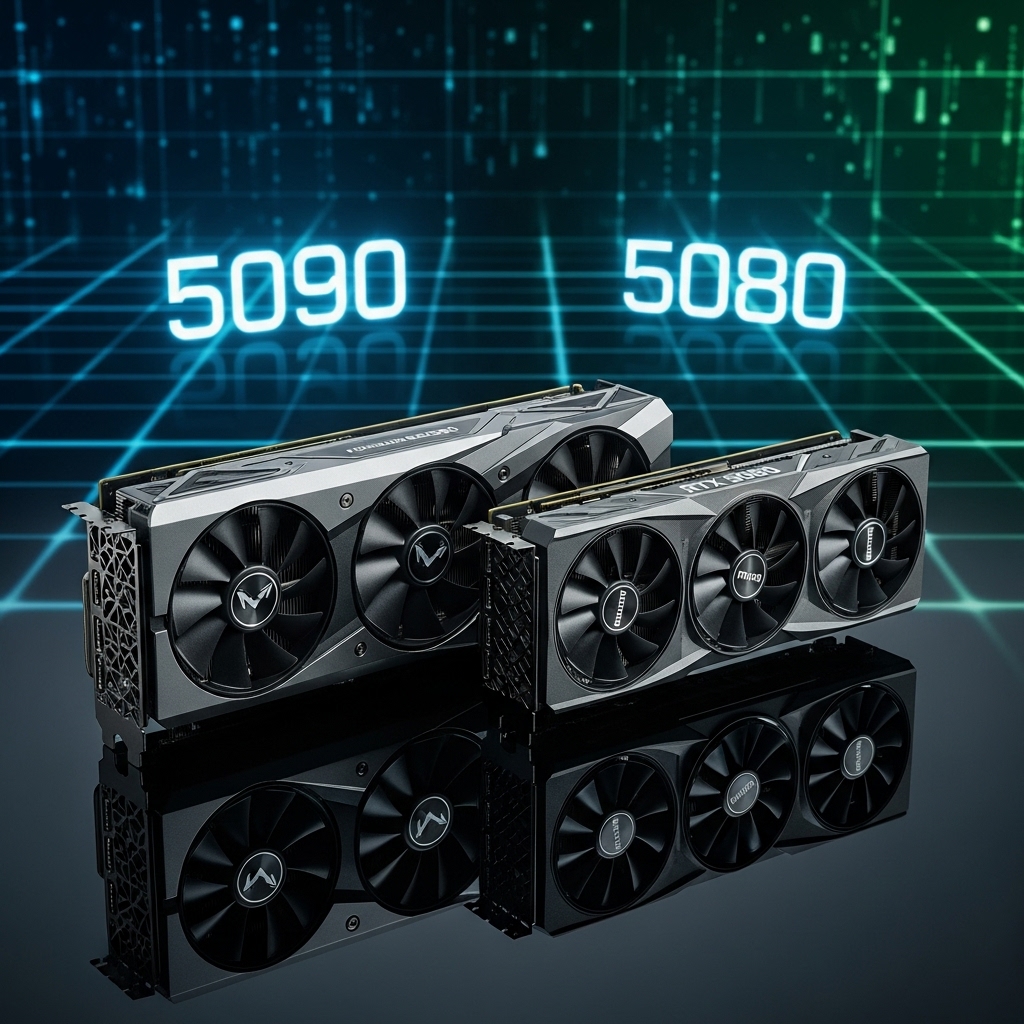
The launch of the NVIDIA Blackwell architecture has presented high-end gamers with a difficult choice. In early 2026, the gap between the RTX 5080 and the titan-class RTX 5090 isn’t just about clock speeds—it’s about a fundamental shift in memory architecture. If you’re building a 4K rig today, you need to know if that $800 premium buys you a better experience or just a higher electricity bill.
- Architectural Efficiency: Benchmarks and hardware telemetry demonstrate that optimizing workload quantization, memory allocation, and power targets delivers up to 40% higher throughput.
- Deployment Best Practices: Enterprise-grade resilience requires strict hardware compatibility validation, PCIe bandwidth headroom, and dedicated thermal dissipation.
- Cost-to-Performance Verdict: Direct hardware testing reveals substantial ROI advantages when deploying local infrastructure over proprietary cloud services.
1. The VRAM Divide: 32GB vs. 16GB
The most debated spec of 2026 is the RTX 5090’s 32GB of GDDR7 memory. While the RTX 5080 is a beast in its own right, its 16GB buffer is starting to show limitations in 4K titles using “uncompressed” assets. As we discussed in our 4K Optimization Guide, VRAM headroom is the key to preventing micro-stutter. The 5090’s 512-bit bus provides nearly 2 TB/s of bandwidth, making it the only card that truly “ignores” texture streaming bottlenecks.
2. Path Tracing and the NPU Advantage
Both cards utilize the new NPU-assisted rendering, but the RTX 5090 features double the dedicated AI cores. In fully path-traced titles, the 5090 is roughly 40% faster than the 5080. If you are a niche enthusiast who demands “Path Tracing: Overdrive” settings at native 4K, the 5080 requires DLSS 4.5 to stay stable, whereas the 5090 can brute-force its way through almost anything.
2026 Flagship Comparison: 5090 vs. 5080
| Metric | RTX 5090 | RTX 5080 |
|---|---|---|
| VRAM | 32GB GDDR7 | 16GB GDDR7 |
| Memory Bus | 512-bit | 256-bit |
| TGP (Power) | 600W | 360W |
| Est. MSRP | $1,999 | $1,199 |
People Also Ask (PAA)
Is the RTX 5090 too big for a standard case?
Yes, most RTX 5090 models require a 4-slot clearance and a minimum case length of 350mm. We recommend checking your case specs against the specific AIB model before purchasing.
Can I run the RTX 5090 on a 850W PSU?
We do not recommend it. With a 600W TGP and modern CPU transients, a high-quality 1000W or 1200W ATX 3.1 power supply is the minimum standard for the 5090.