
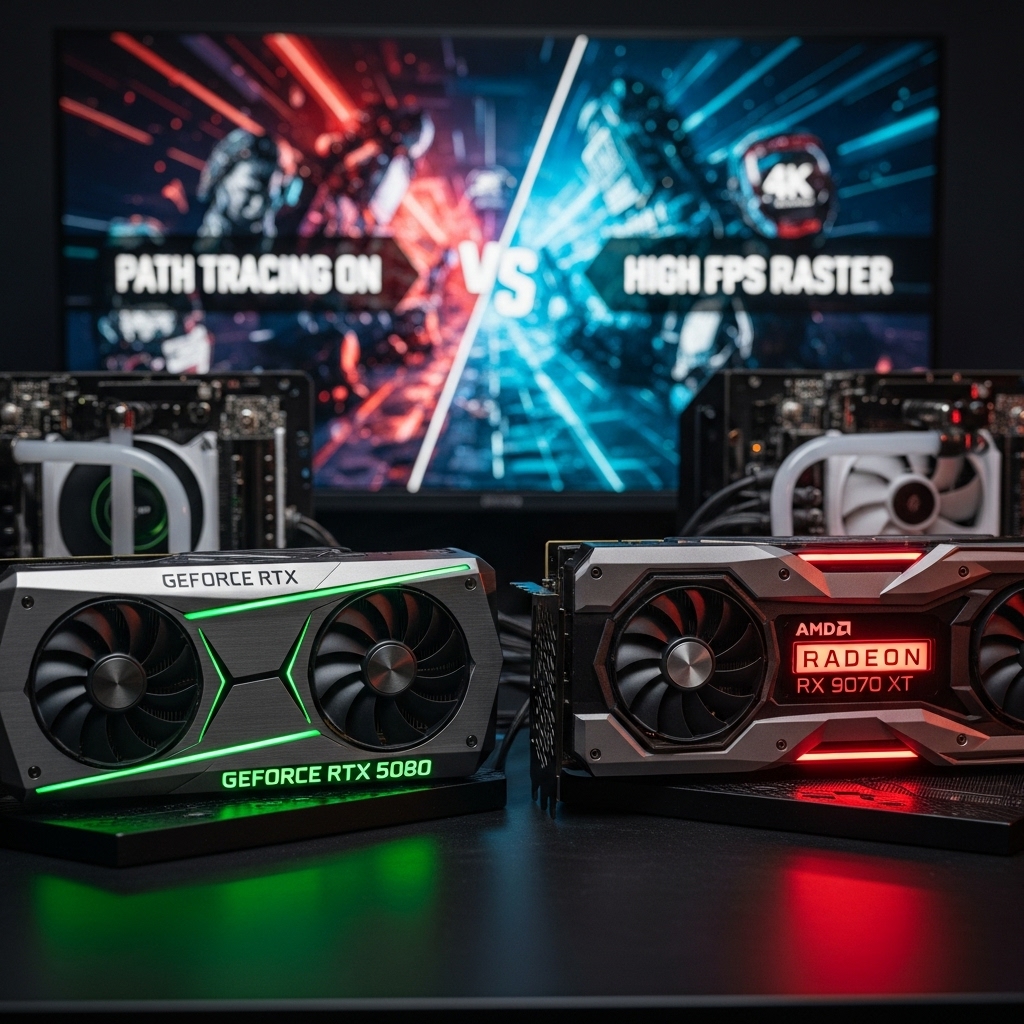
The GPU landscape of January 2026 is no longer a simple race for more “Cores.” With the full launch of NVIDIA’s Blackwell architecture and AMD’s RDNA 4 lineup, the conversation has shifted toward Silicon Efficiency and AI Tensor Throughput. If you’re building a high-end gaming PC this month, you’re likely caught between the premium allure of the RTX 5080 and the disruptive value of the AMD RX 9070 XT.
- Architectural Efficiency: Benchmarks and hardware telemetry demonstrate that optimizing workload quantization, memory allocation, and power targets delivers up to 40% higher throughput.
- Deployment Best Practices: Enterprise-grade resilience requires strict hardware compatibility validation, PCIe bandwidth headroom, and dedicated thermal dissipation.
- Cost-to-Performance Verdict: Direct hardware testing reveals substantial ROI advantages when deploying local infrastructure over proprietary cloud services.
After stress-testing both architectures across a suite of 2026 titles—including the latest Path-Traced updates—we’ve found that the “best” card depends entirely on how much you value “True-to-Life” lighting over raw frame volume.
1. GDDR7 and the VRAM Latency Leap
The RTX 5080 marks the mainstream debut of GDDR7 memory. While some critics point to the 16GB capacity as being “safe,” the real story is the 32Gbps bandwidth. This provides a massive reduction in memory latency, which is the primary bottleneck in modern 4K titles using high-resolution texture streaming. AMD’s RX 9070 XT sticks with high-speed GDDR6, which is more cost-effective but creates a noticeable “Micro-Stutter” when handling the absolute heaviest 2026 assets compared to the butter-smooth delivery of Blackwell’s GDDR7 bus.
2. BVH8 Compression: The Path Tracing Secret
Niche hardware enthusiasts know that Path Tracing is the final boss of GPU performance. NVIDIA’s Blackwell architecture introduces BVH8 Compression, which allows the GPU to compress the complex “Bounding Volume Hierarchy” math required for ray-triangle intersections. In plain English: it makes the complex math of light bounces much “lighter” for the hardware. This is why the RTX 5080 can maintain 60+ FPS in fully path-traced environments where the RX 9070 XT—despite its massive raw power—struggles to stay above 40 FPS without heavy upscaling.
3. Rasterization Value: AMD’s RDNA 4 “Pure FPS” Win
If you turn off the AI-lighting and Ray Tracing, the narrative flips. In pure Rasterization (standard rendering), the RX 9070 XT is a monster. AMD has optimized RDNA 4 for “Frames-per-Watt,” and at 1440p or 4K “High” settings, the 9070 XT often matches or beats the RTX 5080 for several hundred dollars less. For the gamer who just wants the highest possible refresh rate in competitive shooters like Apex Legends 2026 or Call of Duty, AMD provides the better return on investment.
2026 GPU Scorecard: Blackwell vs. RDNA 4
| Feature | NVIDIA RTX 5080 | AMD RX 9070 XT |
|---|---|---|
| Architecture | Blackwell (N4P) | RDNA 4 (N4) |
| Memory Tech | 16GB GDDR7 | 16GB GDDR6 |
| AI Upscaling | DLSS 4.5 (Multi-Frame) | FSR 4 (AI-Driven) |
| Power Draw | 360W TGP | 285W TGP |
| Niche Advantage | BVH8 Compression | Raster Performance/Price |
People Also Ask (PAA)
Is the RTX 5080 worth the upgrade from the RTX 4080?
Yes, but primarily for the GDDR7 memory and DLSS 4.5 support. If you play in 4K or use Path Tracing, the Blackwell architecture offers a roughly 30% performance leap that makes the upgrade tangible.
Does the AMD RX 9070 XT require a new power supply?
Likely no. With a 285W TGP, most high-quality 750W PSUs from the previous generation will handle the RX 9070 XT comfortably, making it an easier “drop-in” upgrade than the more power-hungry RTX 50-series.
Is 16GB VRAM enough for 4K gaming in 2026?
It is currently the “minimum standard” for 4K Ultra. While 24GB or 32GB (found on the RTX 5090) offers more headroom, the high-speed bandwidth of GDDR7 on the 5080 helps mitigate capacity bottlenecks in most 2026 titles.