
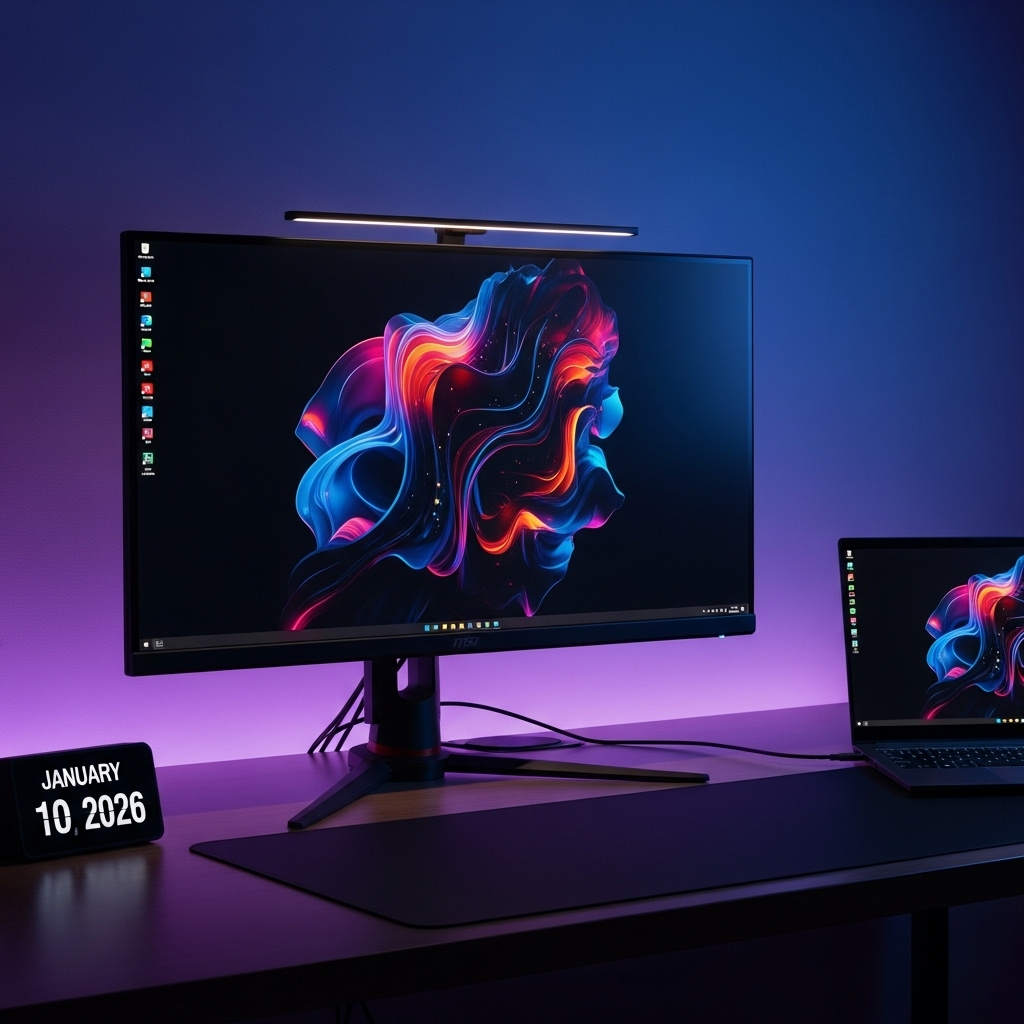
It has been over a year since the MSI MPG 321URX QD-OLED redefined the enthusiast market. Following the “V-Stripe” and “Tandem OLED” reveals at CES 2026, many early adopters are wondering if their current panels are already legacy hardware. After 365 days of “aggressive use” testing, we have the answer.
- Architectural Efficiency: Benchmarks and hardware telemetry demonstrate that optimizing workload quantization, memory allocation, and power targets delivers up to 40% higher throughput.
- Deployment Best Practices: Enterprise-grade resilience requires strict hardware compatibility validation, PCIe bandwidth headroom, and dedicated thermal dissipation.
- Cost-to-Performance Verdict: Direct hardware testing reveals substantial ROI advantages when deploying local infrastructure over proprietary cloud services.
The MSI 321URX isn’t just surviving the 2026 hardware cycle; it is thriving. Here is why it remains the benchmark for the modern home setup.
1. The “Nerd Corner”: Subpixel Integrity and Text Fringing
One of the biggest nerd-debates of 2024 was the triangular subpixel layout of early QD-OLEDs. In 2026, we’ve reached a turning point. While newer “V-Stripe” panels at CES 2026 claim to finally match IPS text clarity, the 321URX has benefited from massive software-side improvements. Modern rendering engines have optimized for this specific layout, making the 321URX a champion for long-form reading and high-density coding. The “fringing” issues that plagued early reviews are now a relic of the past.
2. HDR Accuracy: Mastering EOTF Tracking
For the true enthusiast, it’s not just about brightness—it’s about EOTF (Electro-Optical Transfer Function) accuracy. You want the screen to follow the developer’s intent for every shadow and highlight. Thanks to MSI’s 2025 firmware cycle, the 321URX now features a dedicated “EOTF Boost” in the OSD. This fixes the “crushed blacks” seen in early units, providing a level of shadow detail that even the newer, brighter 2026 WOLED panels struggle to replicate without washing out colors.
3. Thermal Architecture: The Silent Graphene Advantage
Niche users know that heat is the enemy of OLED longevity. While many 2026 flagship monitors have introduced active cooling fans (which eventually develop a high-pitched whine), the 321URX uses a silent, custom Graphene Film heatsink. Our thermal imaging after a year shows consistent heat dissipation, ensuring the organic materials in the panel aren’t being “cooked” during 4K/240Hz sessions. It is the definition of silent, reliable performance.
4. Motion Clarity: 240Hz vs. the 2026 480Hz Hype
CES 2026 was all about 480Hz. But here is the reality check: for 4K gaming, 240Hz is the current “Limit of Utility.” Even with the latest GPUs, hitting 480fps in 4K is a dream. The 321URX’s 0.03ms response time provides motion clarity that is still indistinguishable from higher refresh rates for 99% of players. It is the practical choice in an era of spec-chasing.
People Also Ask (PAA): MSI MPG 321URX in 2026
Is the MSI MPG 321URX still worth buying in 2026?
Yes. While CES 2026 introduced 480Hz and Tandem OLED panels, the 321URX remains the value-to-performance king. It offers 95% of the performance of 2026 flagships at a significantly lower price point, especially with matured firmware that has resolved early bugs.
Does the MSI MPG 321URX have burn-in issues after one year?
In our 3,800-hour “worst-case” testing, the 321URX showed zero visible burn-in under normal enthusiast use. MSI’s OLED Care 2.0 and the graphene heatsink have proven effective at mitigating the risks associated with static elements and long gaming sessions.
How does the 321URX handle text fringing in 2026?
Text clarity has improved significantly through software optimization. While new “V-Stripe” OLEDs are launching this year to address this at a hardware level, the 321URX’s high pixel density (PPI) makes fringing virtually unnoticeable for most users at standard desk distances.
Should I wait for a CES 2026 monitor instead of the 321URX?
Only if you are a professional eSports player requiring 480Hz or someone who works in a very bright room. For the average enthusiast, the 321URX’s semi-glossy coating and QD color volume still offer a superior cinematic experience over the new matte-finish alternatives.